
It is one of the most common questions we get from Indian advertisers, and the honest answer is unsatisfying: comparing Instagram vs Facebook ads on price is the wrong framing, and the businesses that insist on choosing usually end up paying more than those that do not.
That said, Instagram vs Facebook ads is not a meaningless comparison — the two genuinely behave differently, and the differences matter for creative and for audience. This guide gives the real numbers for India, explains when leaning one way makes sense, and why restricting placements usually backfires. For budget-level figures see our guide to Facebook and Instagram ads cost in India.
The actual numbers for India
| Metric | Who wins | ||
|---|---|---|---|
| CPM (per 1,000 impressions) | ₹40 – ₹140 | ₹55 – ₹180 | |
| Click-through rate | 0.7% – 1.4% | 0.9% – 2.1% | |
| Cost per click | ₹4 – ₹20 | ₹5 – ₹22 | Roughly equal |
| Cost per lead | Varies by category | Varies by category | No winner |
| Audience skew | 30 to 55+ | 18 to 34 | Depends on you |
| Video performance | Good | Stronger |
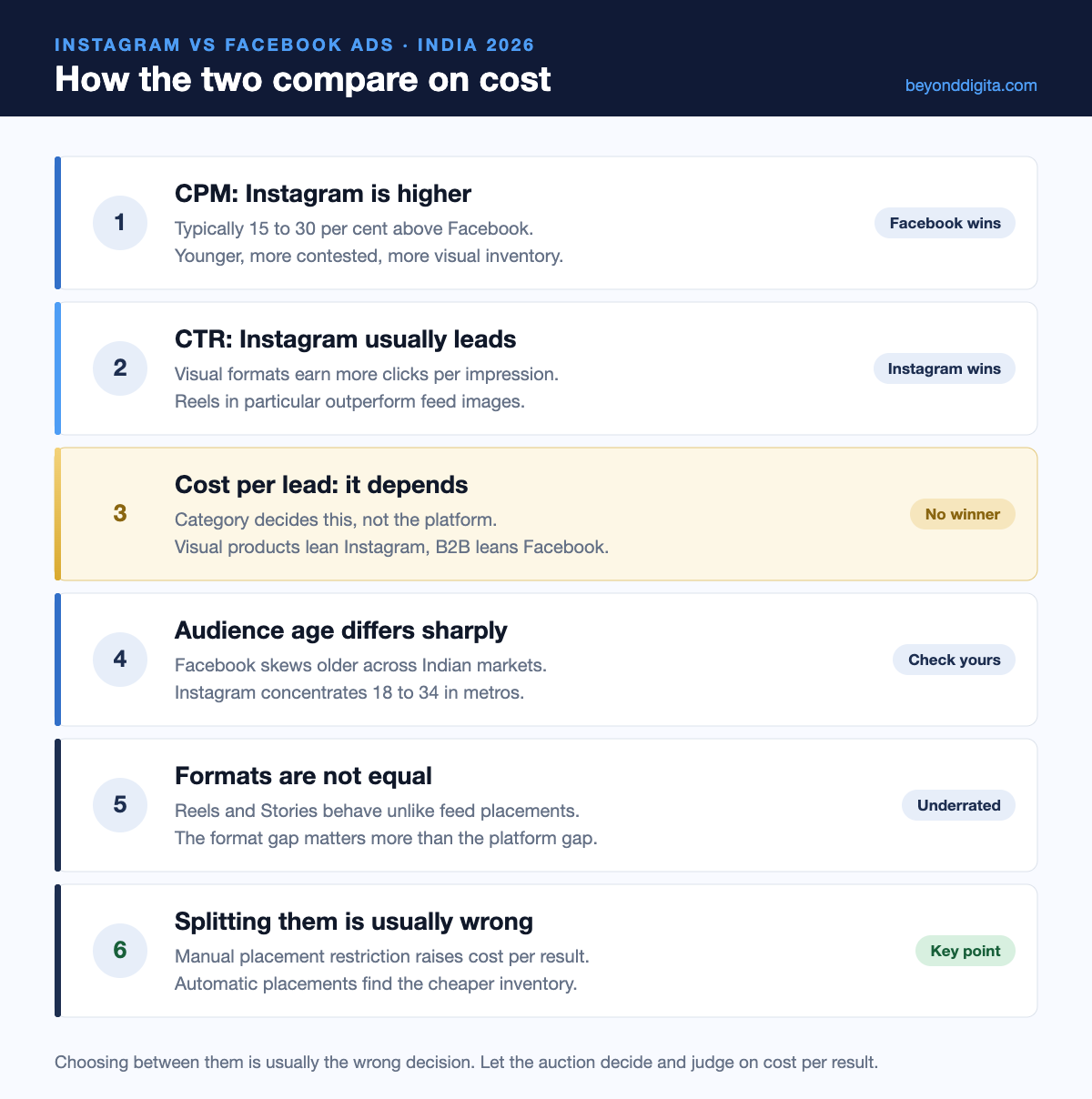
Read the first two rows together. Instagram costs more per impression and earns more clicks per impression, so the cost per click lands in roughly the same place. That is the core finding of any honest Instagram vs Facebook ads comparison in India: the differences largely cancel out.
These are directional ranges from Indian SMB accounts, not guarantees. Your category, city and season move them considerably, as our guide to Facebook CPM by industry sets out.
Why splitting them is usually a mistake
Here is the part of the Instagram vs Facebook ads question most advertisers resist. Restricting a campaign to one platform — or splitting budget manually between them — reliably produces worse results than letting Meta choose.
Automatic placements let the system buy whichever inventory is cheapest for your objective at that moment. On a Tuesday afternoon that might be Instagram Reels; on a Saturday evening it might be Facebook feed. A manual Instagram vs Facebook ads split freezes a decision that should be made thousands of times a day.
We see “Feed only” or “Instagram only” settings in a large share of the accounts we audit, and removing the restriction is frequently the single change that improves cost per result most. Meta’s placement documentation explains the full inventory available.
When leaning one way does make sense
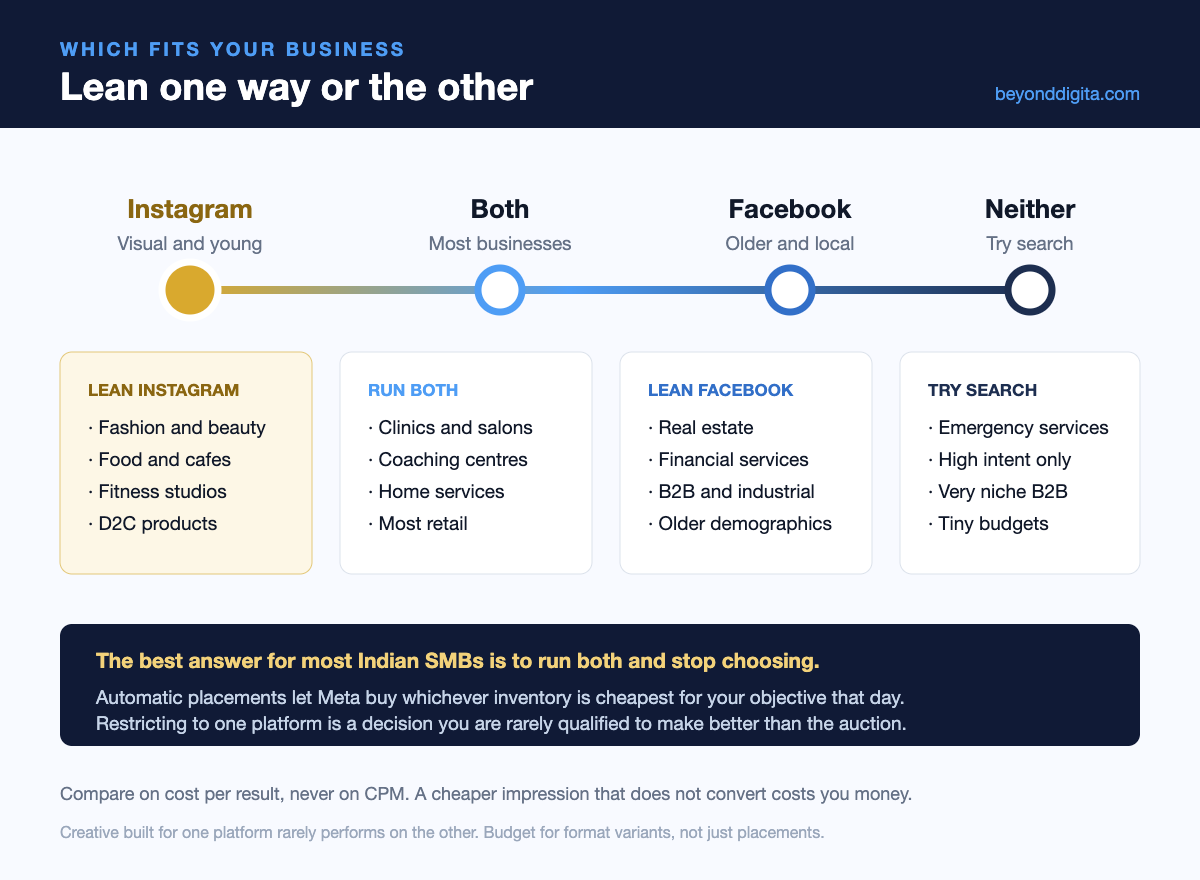
There are legitimate reasons to weight one side of an Instagram vs Facebook ads split, and they are about audience and creative rather than price.
Lean Instagram when
Your product is visual and your buyer is under 35. Fashion, beauty, cafés, fitness studios, interiors and most D2C brands fall here. The decision in an Instagram vs Facebook ads choice is really “is my product worth looking at”, and for these categories it is.
Lean Facebook when
Your buyer is older or the purchase is considered, which tilts Instagram vs Facebook ads firmly one way. Real estate, financial services, B2B and industrial products reach decision-makers more reliably on Facebook in India, where the user base skews meaningfully older.
Run both when
You are anything else — which is most businesses. Clinics, salons, coaching centres, home services and general retail all have buyers on both, and the Instagram vs Facebook ads question answers itself once you stop asking it.
Consider neither when
Your demand is emergency-driven or highly specific. Nobody scrolls Instagram hoping to find a plumber at 11pm. That demand lives in search, as we cover in SEO vs Google Ads.
What the audience difference really means
The demographic split underlying Instagram vs Facebook ads in India is real and larger than in most markets, but it is routinely misread.
| Audience | Where they are | What it means for you |
|---|---|---|
| 18–24, metro | Heavily Instagram | Vertical video, trends, creators |
| 25–34, metro | Both, Instagram leading | Run both, weight creative to Reels |
| 35–50, metro | Both, Facebook leading | Longer copy performs better |
| Over 50 | Strongly Facebook | Clear offers, bigger text, simple flow |
| Tier 2 and 3 cities | Facebook still dominant | Cheaper inventory, less competition |
The last row is the one Delhi NCR advertisers miss. If you sell beyond the metros, the Instagram vs Facebook ads balance shifts noticeably toward Facebook, and the inventory there is materially cheaper than in Delhi, Mumbai or Bangalore.
Do not use that table to exclude anyone, though. Use it to decide what creative to produce. An ad written for a 22-year-old and an ad written for a 48-year-old are different ads, and automatic placements will find both audiences if you give the system something suitable to show each of them.
A worked example
A salon in Mayur Vihar ran ₹1,000 a day for a month, split manually — ₹500 to an Instagram-only ad set, ₹500 to a Facebook-only ad set. Instagram delivered 38 leads at ₹395; Facebook delivered 31 at ₹484. The obvious conclusion to that Instagram vs Facebook ads test was to move everything to Instagram.
Instead we consolidated into one ad set at ₹1,000 a day with automatic placements and the same creative. The following month produced 94 leads at ₹319. No new creative, no new audience, no increase in budget — the gain came entirely from removing a manual Instagram vs Facebook ads split that was forcing the system to spend where it did not want to.
Two ad sets of ₹500 also sit closer to the learning threshold than one ad set of ₹1,000, which compounds the problem at small budgets. That interaction is covered in our guide to the Meta ads minimum budget.
The format gap matters more than the platform gap
This is the finding that surprises most advertisers worrying about Instagram vs Facebook ads. The performance difference between Reels and a feed image is far larger than the difference between the two platforms.
- Reels deliver the cheapest reach on both platforms in India, and reward native vertical video built to Meta’s Reels specifications.
- Stories convert well for time-limited offers but burn creative quickly.
- Feed is the most expensive placement and still the most reliable for considered purchases.
- Audience Network is cheapest and usually worth least — watch it against your landing page conversion rate rather than excluding it reflexively.
- Repurposed landscape video underperforms badly in every vertical placement. Shoot vertical or crop properly.
Spending an afternoon producing proper vertical creative will do more for results than any Instagram vs Facebook ads allocation decision you could make, and our guide to short video covers the production side.
How to actually decide, with data
Settle Instagram vs Facebook ads with your own data. Run automatic placements for four weeks at a stable budget. Then open the placement breakdown in Ads Manager and read where your results actually came from.
That report settles the Instagram vs Facebook ads question for your business specifically, which no benchmark table can. If 80% of your conversions came from Instagram Reels, you now know something true about your buyers rather than something general about Indian advertising.
Even then, resist restricting placements. Use the finding to decide where creative effort goes, not to limit where the auction can spend. Verify the numbers against your own records in GA4 rather than trusting platform attribution alone.
Frequently asked questions
Is Instagram more expensive than Facebook in India?
On Instagram vs Facebook ads CPM, yes — Instagram usually runs 15 to 30 per cent higher. Per result, often not, because the click-through rate is better. Judge on cost per result only.
Can I run one ad across both?
Yes, and you should. One campaign spanning Instagram vs Facebook ads with automatic placements is the default we recommend. Supply multiple creative ratios so each placement gets something appropriate.
Do I need a Facebook page for Instagram ads?
Yes. Running Instagram vs Facebook ads both goes through Meta’s business tools, which require a linked Page. Meta documents the setup in its account requirements.
Which is better for lead generation?
Neither side of Instagram vs Facebook ads wins inherently. Lead quality depends on the form, the offer and your follow-up speed far more than on placement, as covered in our guide to cost per lead benchmarks.
Stop choosing, start measuring
The Instagram vs Facebook ads debate consumes more attention than it deserves, and rarely changes what you should actually do. For nearly every Indian SMB the right answer is one campaign, automatic placements, good vertical creative, and a monthly look at where results came from.
If your account currently restricts placements and you are not sure why, send us access. Our performance marketing team will tell you what that restriction is costing you — it is frequently the cheapest improvement available in the whole account.