
Cost per thousand impressions is the number everyone quotes and almost nobody interprets correctly. A client sees Facebook CPM rise from ₹60 to ₹110 and assumes something has broken, when the campaign may be performing better than it was. Another sees a very low figure and celebrates reach that converts nothing.
This guide gives realistic Facebook CPM benchmarks for Indian accounts by industry, explains the four things that actually set your number, and shows when a rising cost is a warning and when it is simply the auction doing its job. For the wider picture on budgets, see our guide to Facebook and Instagram ads cost in India.
What Facebook CPM actually measures
Facebook CPM is what you pay for one thousand impressions — not clicks, not reach, not people. The same person seeing your ad five times produces five impressions, which is why frequency quietly inflates the denominator and flatters a campaign that is simply repeating itself.
It is also an outcome, not a setting. You do not choose your Facebook CPM; it is the price the auction charges to put your ad in front of the people you asked for. Every lever you pull — audience, creative, placement, objective — changes that price indirectly.
That distinction matters because most attempts to “reduce CPM” make results worse. Broadening an audience until the cost falls usually buys cheaper impressions in front of people who will never buy.
Facebook CPM benchmarks for India in 2026
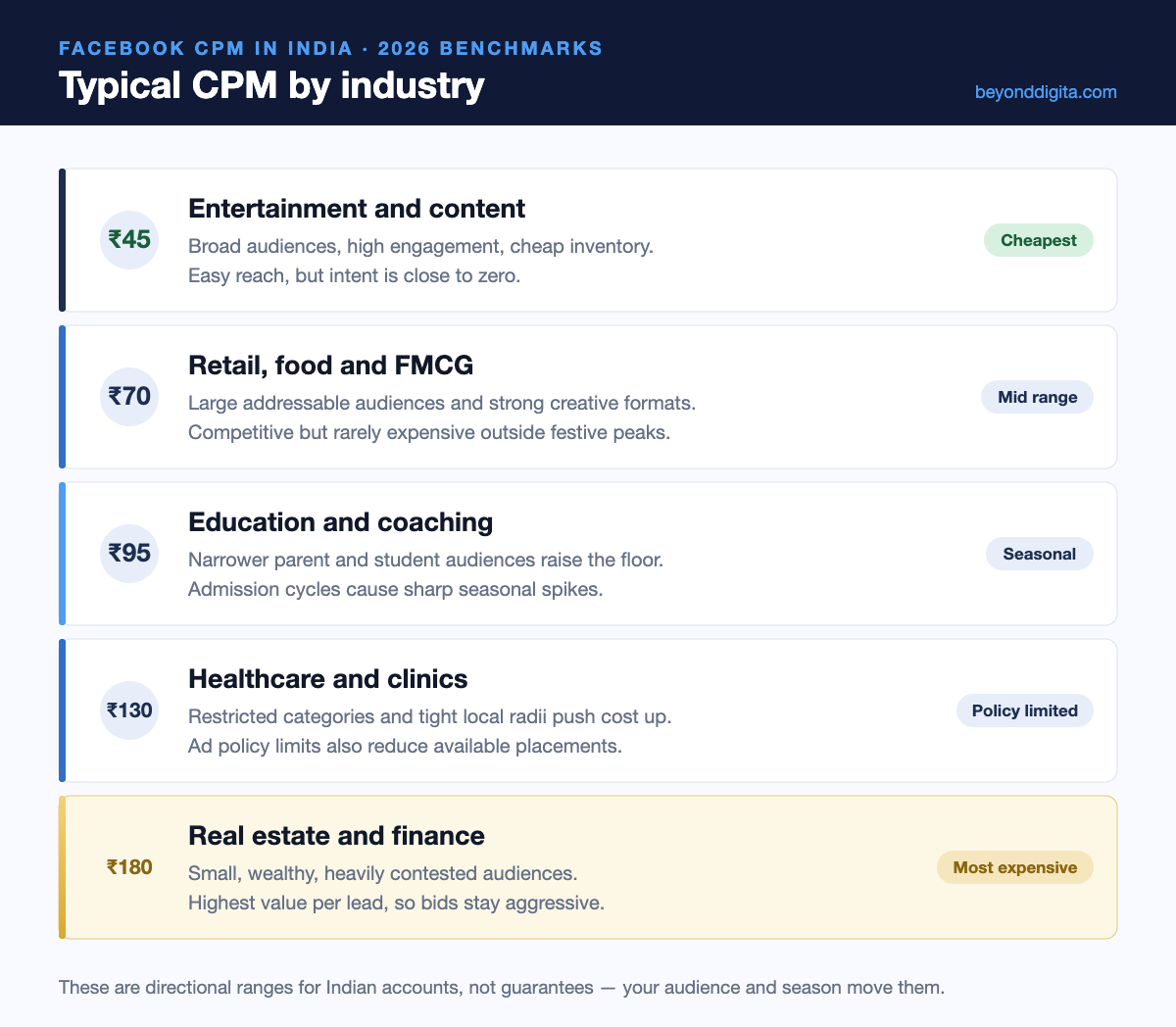
| Industry | Typical CPM range | What drives it |
|---|---|---|
| Entertainment and media | ₹30 – ₹60 | Huge audiences, cheap inventory |
| Retail and FMCG | ₹50 – ₹90 | Broad reach, strong creative formats |
| Restaurants and food | ₹45 – ₹85 | Local radii, high engagement |
| Education and coaching | ₹70 – ₹120 | Narrow parent audiences, admission cycles |
| Healthcare and clinics | ₹100 – ₹160 | Restricted category, tight geography |
| B2B and industrial | ₹110 – ₹200 | Very small addressable audience |
| Real estate and finance | ₹140 – ₹220 | High lead value, aggressive bidding |
Treat these as starting points for a conversation, not promises. We publish them because the alternative — agencies quoting a single national Facebook CPM figure — is worse. Your own account is the only benchmark that genuinely matters, and a month of your own data beats any table on the internet.
Metro audiences in Delhi NCR, Mumbai and Bangalore sit at the upper end of each range. Tier-two and tier-three cities are routinely 30–50% cheaper for the same category, which is why tight geographic targeting changes economics more than most bidding tweaks.
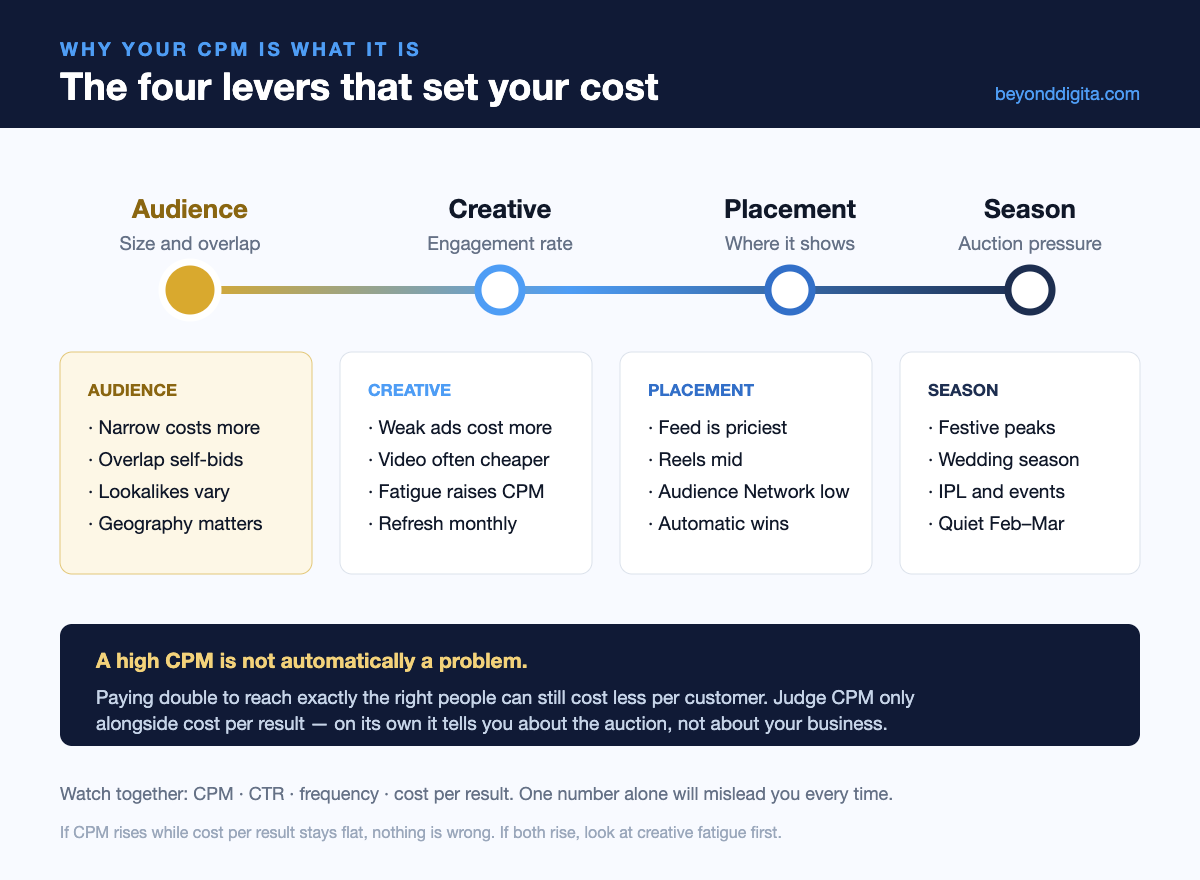
The four levers that set your Facebook CPM
Audience
Narrow audiences cost more per impression — there are fewer people to serve and more advertisers chasing them. Overlapping ad sets are worse still, because you end up bidding against yourself. Consolidating three overlapping ad sets into one often drops Facebook CPM immediately with no other change — the same consolidation logic we apply to paid search accounts.
Creative
Meta rewards ads people engage with by charging less to show them, documented in its explanation of how the auction works. A strong creative genuinely lowers your Facebook CPM, and a tired one raises it week by week as fatigue sets in. This is the lever with the most room in most accounts, and the one owners touch least.
Placement
Feed placements cost most, Reels sit in the middle, and Audience Network is cheapest — and usually worth least. Restricting placements to “Feed only” is one of the most common ways Indian advertisers accidentally double their Facebook CPM. Automatic placements almost always win, and Meta lists the full inventory in its placement guide.
Season
Auction pressure is seasonal and predictable. Expect sharp rises through the festive period and wedding season, and a noticeably cheaper window in February and March — the pattern we mapped in our festive marketing playbook. A budget planned in a quiet month will underdeliver in a busy one at the same spend.
How CPM differs by objective
The campaign objective you choose changes the price before any targeting is applied, because it changes who Meta tries to find. Asking for conversions means asking for a much smaller pool of people predicted to act, and that pool is expensive.
| Objective | Relative CPM | Use it when |
|---|---|---|
| Reach / Awareness | Lowest | Launches, local brand building |
| Traffic | Low to mid | Content distribution, blog promotion |
| Engagement | Low | Social proof, rarely a business goal |
| Leads | High | Service businesses with a clear offer |
| Sales / Conversions | Highest | Ecommerce with working tracking |
This is why comparing your Facebook CPM to someone else’s is close to meaningless unless you know their objective. A reach campaign at ₹40 and a conversion campaign at ₹160 are not evidence that one advertiser is better than the other.
It also explains a common false alarm. Switching from Traffic to Leads will roughly double your Facebook CPM overnight, and that is correct behaviour rather than a fault — you are now paying to reach people likely to fill in a form. Our guide to Meta Advantage+ for lead generation covers when that trade is worth making.
What a high CPM is actually telling you
An expensive auction is usually a signal that other advertisers have found the same audience valuable. That is information, not a problem. Real estate and finance carry the highest Facebook CPM in India precisely because a single closed deal pays for months of impressions.
The question to ask is whether your unit economics survive it. Divide an acceptable acquisition cost by your lead-to-customer rate, and you have a ceiling. If a ₹180 Facebook CPM still produces leads below that ceiling, the number is irrelevant — and if it does not, no bidding tactic will rescue it. Either the offer, the landing page or the channel has to change.
For many local service businesses the honest answer is that search captures existing demand more cheaply, and social is better used to create it. That is the trade-off we set out in SEO vs Google Ads, and it applies equally to Meta.
When a rising CPM is fine, and when it is not
| What you see | What it means | Action |
|---|---|---|
| CPM up, cost per result flat | Auction got busier; you are fine | Nothing |
| CPM up, cost per result up | Creative fatigue, most likely | Refresh creative |
| CPM up, frequency above 4 | Audience too small | Expand or exclude |
| CPM down, results down | Reaching cheaper, worse people | Tighten targeting |
| CPM down, results up | Creative is working | Scale carefully |
The second row covers most real problems. When Facebook CPM and cost per result rise together over a week or two, the ad has usually been seen too often by the same people. Check frequency before changing anything else, and see our landing page CRO guide if the clicks are arriving but not converting.
How to lower Facebook CPM without wrecking results
- Refresh creative every three to four weeks. The single most reliable way to bring Facebook CPM down in a healthy direction.
- Use automatic placements. Letting Meta find cheap inventory beats manual restriction almost every time.
- Consolidate overlapping ad sets. Fewer, larger ad sets stop you bidding against yourself.
- Exclude recent converters. You are paying to re-reach people who already bought.
- Test video. Video frequently earns cheaper impressions than static in Indian auctions.
- Avoid peak weeks for non-seasonal offers. Do not fight the festive auction with an evergreen campaign.
Notice that none of these are bidding changes. Manual bid caps rarely improve Facebook CPM in small Indian accounts and frequently stop delivery altogether.
Reading CPM alongside everything else
On its own, Facebook CPM tells you about the auction. It tells you nothing about whether your advertising is working. The businesses that use it well watch four numbers together: CPM, click-through rate, frequency, and cost per result.
A real estate advertiser paying ₹200 per thousand impressions and acquiring site visits at ₹900 is doing better than a competitor paying ₹60 and acquiring nothing. Meta’s ad auction documentation explains why: the auction optimises for total value, not for the lowest price. Meta’s ad standards also restrict some categories outright, which lifts cost in healthcare and finance.
Verify against your own records rather than the platform’s. Meta’s attribution is generous, so compare reported results to what lands in your CRM or in GA4 each month, and build the first-party data that lets you judge campaigns on revenue.
Frequently asked questions
What is a good Facebook CPM in India?
Between roughly ₹50 and ₹150 covers most Indian SMB accounts. “Good” depends entirely on category — ₹150 is excellent for finance and poor for entertainment.
Why did my CPM double suddenly?
A sudden doubling usually has one of three causes: festive auction pressure, creative fatigue, or an audience edit that narrowed delivery. Check the date against the festive calendar first, then frequency.
Is Instagram CPM higher than Facebook?
Slightly, in most Indian categories. It often delivers better cost per result for visual products, so the higher Facebook CPM comparison rarely decides where budget should go.
Does a higher budget raise CPM?
Eventually, yes. Scaling spend into a fixed audience forces Meta to buy more expensive impressions. Expanding the audience as you scale keeps Facebook CPM stable for longer.
Judge the outcome, not the input
Most accounts we audit are optimising the wrong number. They have driven Facebook CPM down by broadening audiences and restricting placements, and in doing so made every downstream metric worse.
If your costs have moved and you are not sure which of the four levers caused it, our performance marketing team will read the account and tell you. Send us access — we will give you a straight answer about whether anything is actually wrong.