
Meta will accept almost any budget you offer it. Set ₹100 a day and the campaign runs, impressions appear, and the dashboard fills with numbers. That is precisely the problem: the Meta ads minimum budget the platform allows and the minimum that can actually produce customers are two very different figures.
This guide separates the three floors that get confused, shows how to calculate your own rather than borrowing a benchmark, and sets out what to do instead when your budget genuinely sits below the line. For the wider cost picture, see our guide to Facebook and Instagram ads cost in India.
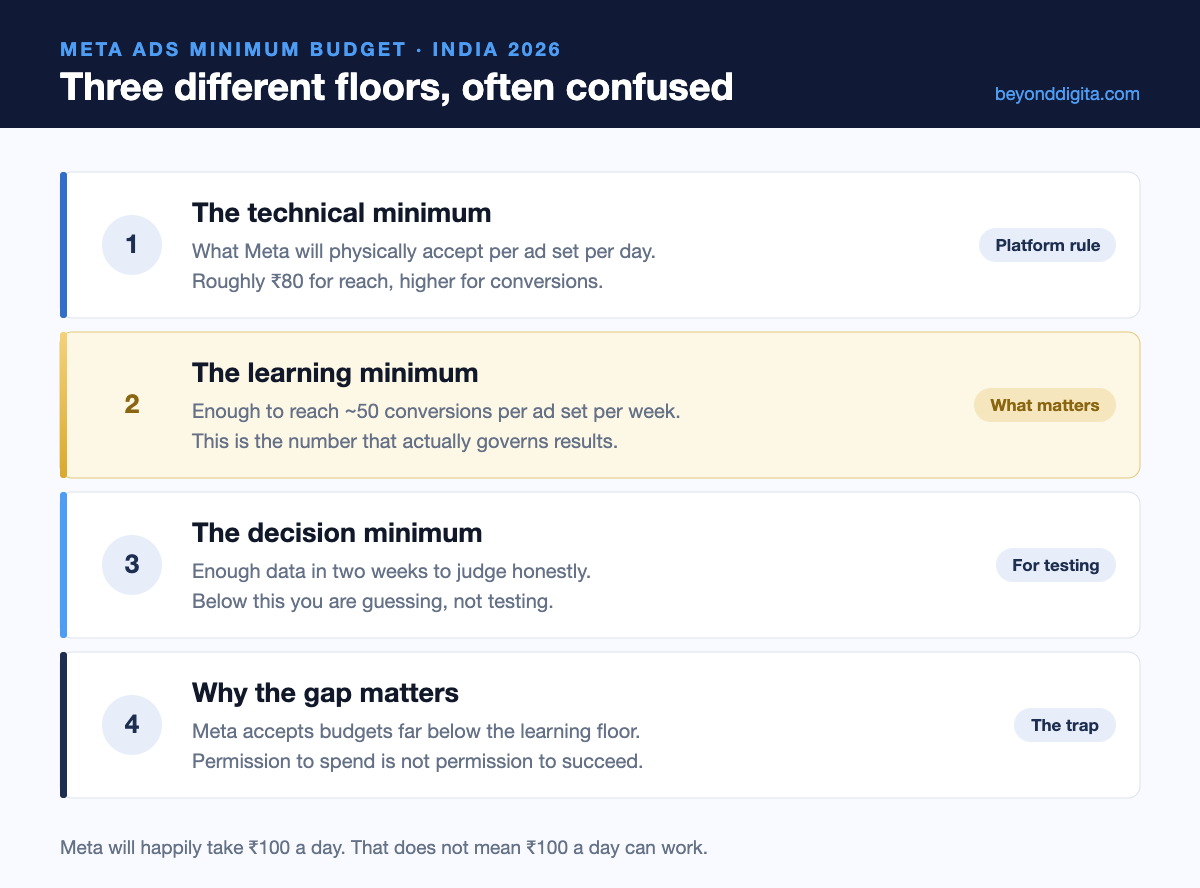
The technical minimum, which matters least
Meta enforces a hard Meta ads minimum budget per ad set per day, scaled by objective. For impression-based objectives it sits around ₹80 in India. For conversion objectives — the ones most businesses actually want — it is several times higher, because Meta needs room to find people likely to act, as its ad auction documentation explains.
This technical Meta ads minimum budget is the number most articles quote, and it is close to useless. It tells you what the platform will accept, not what will work. Meta’s own guidance on choosing an objective sets the rule without claiming it is sufficient.
The learning minimum, which decides everything
Meta’s delivery system needs roughly fifty conversions per ad set per week to exit the learning phase and optimise reliably. Below that threshold it is guessing, so a Meta ads minimum budget under the line keeps costs high and unstable, and your reporting swings wildly from one day to the next.
That single fact sets the real Meta ads minimum budget for your business. If your cost per lead is ₹150, fifty conversions a week costs ₹7,500 — a Meta ads minimum budget of about ₹1,070 a day. If your cost per lead is ₹600, the same requirement costs ₹4,300 a day. Meta documents the learning phase openly, which makes this arithmetic checkable rather than a matter of opinion.
| Your cost per lead | Weekly budget for 50 results | Daily floor |
|---|---|---|
| ₹60 | ₹3,000 | ~₹430 |
| ₹100 | ₹5,000 | ~₹715 |
| ₹150 | ₹7,500 | ~₹1,070 |
| ₹300 | ₹15,000 | ~₹2,140 |
| ₹600 | ₹30,000 | ~₹4,300 |
| ₹1,200 | ₹60,000 | ~₹8,570 |
Read that Meta ads minimum budget table as a floor rather than a recommendation. It is the point below which Meta cannot optimise properly — not a promise that spending it will succeed.
How to calculate your own minimum
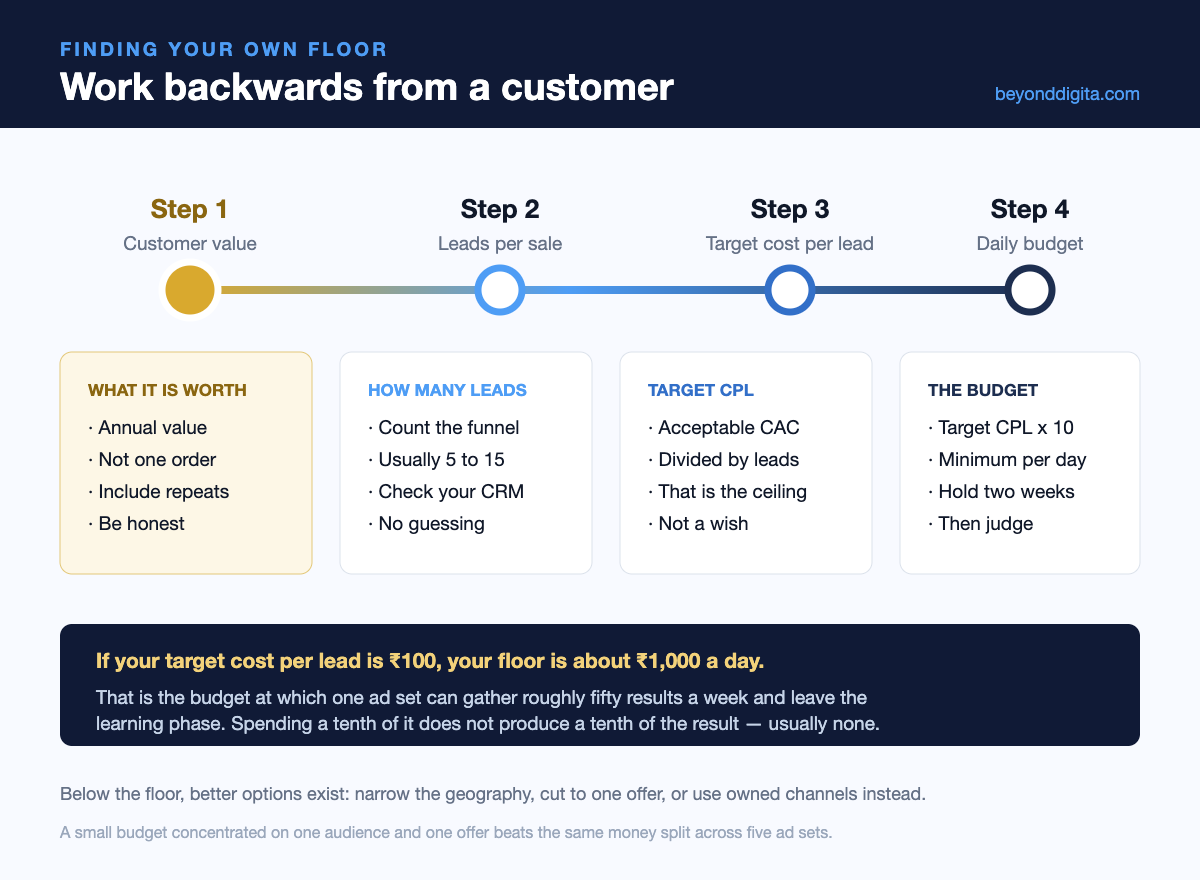
Work from a customer backwards, because a borrowed Meta ads minimum budget cannot know what your customers are worth.
- What is a customer worth over a year, including repeat purchases?
- How many leads do you close per customer? Check your records rather than guessing — most Indian service businesses sit between five and fifteen.
- Decide an acceptable acquisition cost, then divide by the leads figure. That is your target cost per lead.
- Multiply the target cost per lead by ten. That is your realistic Meta ads minimum budget per day.
A salon valuing a client at ₹8,000 a year and closing one in six enquiries can accept ₹200 per lead, giving a floor near ₹2,000 a day. A tuition centre with a ₹4,500 annual value and a one-in-ten close rate lands nearer ₹450. The same Meta ads minimum budget cannot possibly apply to both.
What to do if you are below the floor
Running anyway, below the Meta ads minimum budget your maths demands, is the worst option — and the one most businesses choose. A budget below the learning floor spread across a large audience produces exactly the experience that makes owners conclude Meta does not work for them.
- Shrink the geography. One locality at 3km radius instead of all of Delhi NCR. Fewer people, far cheaper to reach meaningfully, and the approach we set out in hyperlocal advertising.
- Run one offer, one ad set. Concentration beats coverage at small budgets, always — the same logic behind a tight landing page.
- Switch objective. A traffic or engagement campaign has a much lower Meta ads minimum budget than conversions, because the events are cheaper and more frequent.
- Run in bursts. ₹2,000 a day for ten days beats ₹200 a day for a hundred. Same money, usable data.
- Use owned channels instead. Profile Posts, reviews and WhatsApp cost time rather than media budget.
- Consider search instead. Google Ads can work at lower budgets because intent is already present, as we cover in SEO vs Google Ads.
The burst approach is the one most owners have never considered, and it is the best answer to a tight Meta ads minimum budget. Concentrating a month’s budget into ten days clears the learning floor and tells you whether the offer works at all — information that a trickle never produces.
How the objective changes your minimum
The objective you pick changes the floor more than any other single setting, because it changes what counts as a conversion. Fifty link clicks a week is cheap. Fifty purchases a week is not.
| Objective | Optimisation event | Relative daily floor |
|---|---|---|
| Reach | Impressions | Lowest |
| Traffic | Link clicks | Low |
| Engagement | Post interactions | Low |
| Leads (Instant Form) | Form submissions | Moderate |
| Leads (website) | Site form fills | High |
| Sales | Purchases | Highest |
This gives genuinely constrained advertisers a route forward. An Instant Form campaign has a lower Meta ads minimum budget than a website conversion campaign, because the form sits inside Meta and submissions are more frequent and cheaper. The leads are colder, but at small budgets colder leads you can actually generate beat warmer ones you cannot.
The trade-off is real and worth naming. Instant Forms produce volume; landing pages produce qualification. If your Meta ads minimum budget forces you toward forms, compensate with fast follow-up — speed of reply matters more than lead quality at that end of the market, and our Advantage+ lead generation guide covers how to filter them.
When a small budget is the right choice
Not every low budget is a mistake. There are three situations where deliberately spending below the learning floor is defensible, provided you know that is what you are doing.
Retargeting a small warm audience is the clearest case. If only four hundred people visited your site last month, you do not need a large Meta ads minimum budget to reach them several times — the audience itself caps the spend. Brand presence in a tight local radius is the second: a modest, continuous spend keeps a local business visible without any conversion goal attached.
The third is validation. Spending ₹5,000 over a week to discover whether anyone responds to an offer is a reasonable experiment, as long as you treat the result as directional. What you cannot do is run that test and conclude the channel does not work. Build an owned audience alongside it through first-party data, which costs nothing per impression and compounds.
Budget mistakes below the floor
| Mistake | Why it fails |
|---|---|
| Five ad sets on ₹1,000 total | Each gets ₹200 — none can learn |
| Changing budget daily | Resets learning every time |
| Judging after three days | No statistical signal exists yet |
| Broad audience, small spend | Reaches nobody often enough to matter |
| Conversion objective with no Pixel | Meta optimises toward nothing |
| Boosting posts | Optimises for engagement, not business results |
The first row accounts for most wasted spend we see in small accounts. Splitting a modest Meta ads minimum budget across several ad sets feels like testing, but it guarantees that none of them gather enough data to be worth reading.
Frequently asked questions
What is the absolute Meta ads minimum budget in India?
The technical Meta ads minimum budget is around ₹80 per ad set per day for reach objectives. Practically, ₹500 is the floor at which anything can be learned, and conversion campaigns usually need more.
Can I run ads on ₹200 a day?
You can. Whether a Meta ads minimum budget of ₹200 produces customers is another matter. At that level, narrow to one small area and one offer, or save the money for a ten-day burst instead.
Does the minimum change during festive season?
Effectively yes. Auction costs rise, so the same fifty weekly conversions cost more, pushing your real Meta ads minimum budget up by twenty to fifty per cent in peak weeks.
Is a lifetime budget better for small spends?
Sometimes. A lifetime Meta ads minimum budget across a short burst gives Meta flexibility to spend where results are best, which suits the concentrated approach described above.
Spend enough or spend differently
There is no shame in a small budget. The mistake is running a campaign designed for a large one at a tenth of the money and concluding the channel is broken.
Calculate your real Meta ads minimum budget from customer value, and if you cannot reach it, concentrate rather than dilute. If you want a straight answer on whether your current budget can work, our performance marketing team will do that arithmetic with you. Get in touch — sometimes the honest answer is that the money is better spent on local SEO first.