
Plumbers, electricians, pest control firms, mobile car detailers, event caterers, home tutors, packers and movers — a large share of Delhi NCR’s economy travels to the customer. On Google, that makes you a service area business, and it comes with a different rulebook from the shop down the road.
The rules are not harder. They are just less documented, and the penalty for getting them wrong is severe: a suspended profile takes weeks to recover and your leads stop the same day. This guide covers how a service area business should be set up, what actually moves rankings once it is, and the mistakes that cause most suspensions.
What counts as a service area business
Google’s distinction is simple: do customers come to you, or do you go to them? If they never visit your premises, you are a service area business and your address must be hidden. If some visit and some do not — a salon that also does home appointments, a workshop that collects vehicles — you are a hybrid, and you keep the address visible while also declaring the areas you travel to.
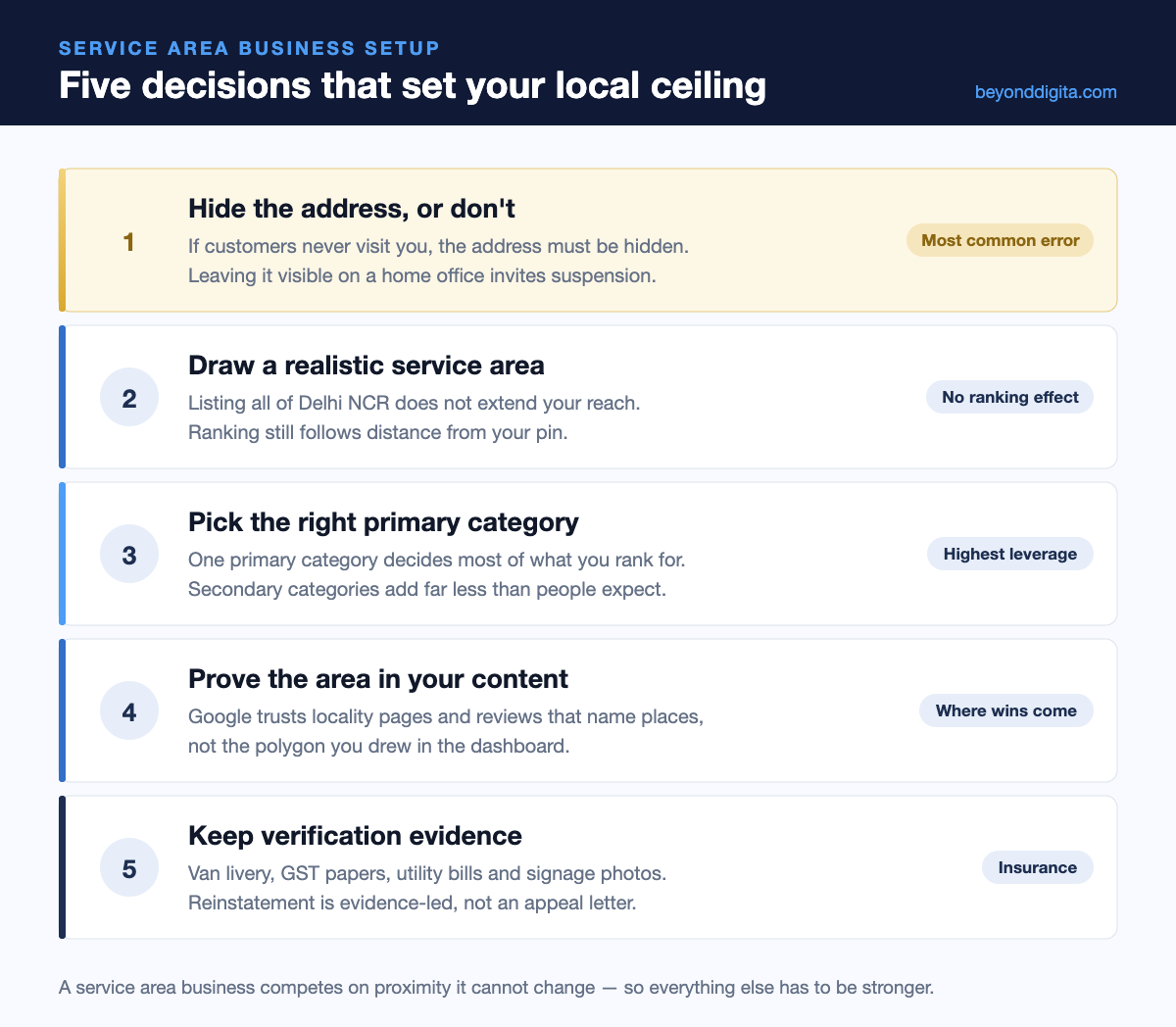
Getting this classification wrong is the single most common cause of suspension. A service area business run from a flat in Lajpat Nagar with the address showing is a guideline breach, and Google’s own documentation on service areas is explicit about it. The listing may run fine for months, then disappear during a routine sweep.
You still need a real address to verify. A service area business simply does not display it. That distinction trips up a lot of owners who assume hiding the address means they can invent one.
The service area you draw does not extend your reach
This is the most expensive misunderstanding in the category, so it is worth stating plainly: drawing a larger service area does not make you rank in more places.
The polygon or list of areas in your Business Profile dashboard tells customers where you are willing to travel. It is not a ranking input. Local rankings for a service area business are still calculated from the pin you verified, weighted by relevance and prominence. Adding all of Delhi, Gurugram, Noida, Ghaziabad and Faridabad does nothing except set expectations you may not want to meet.
| What owners believe | What actually happens |
|---|---|
| A bigger service area means wider ranking | No ranking change; proximity to the pin still governs |
| Twenty areas listed beats five | Identical ranking; more unqualified enquiries |
| Keywords in the business name help | Guideline breach and a common suspension trigger |
| Secondary categories broaden reach | Small effect; the primary category does the work |
| A virtual office extends coverage | Removal and, often, a hard suspension |
Keep the declared area honest — the places you will genuinely travel to profitably. Then do the work that actually widens reach, which happens off the dashboard entirely.
How a service area business actually widens its reach
If the polygon does nothing, what does? Three things, in order of how much they move the needle for a service area business.
Locality pages that are genuinely different
A page per area you serve, each with real local detail — the jobs you have done there, travel times, parking and access notes, named landmarks, local pricing differences. Thin pages that swap one place name for another are a liability for a service area business, not an asset. Our guide to scaling locality pages without getting penalised covers where the line sits.
Reviews that name the area
A review saying “came out to Indirapuram within two hours” is worth more to a service area business than a dozen five-star ratings with no text. Reviewers naming suburbs build the geographic relevance the dashboard cannot. There are twelve practical ways to ask in our guide on getting more Google reviews, and the asking is what most firms skip. Replies matter too, which is the core of reputation management.
Consistent citations
Name, address and phone details that match everywhere they appear. For a service area business this needs care, because many directories demand a public address. Where that is unavoidable, use one consistent format everywhere and never mix variants, or you create exactly the contradictory signals that make Google doubt the listing.
Categories matter more than almost anything else
Your primary category determines the bulk of the queries a service area business is eligible for. It is a single field, chosen in a minute, and it caps what every other effort can achieve.
Pick the most specific category that genuinely describes your main work. “Electrician” and “Electrical installation service” surface for different searches. If a service area business spans several trades, choose the one that carries the margin and add the rest as secondary categories — then build separate pages on your site for the others, because the categories alone will not carry them.
Changing the primary category on an established listing can cause a ranking wobble for a week or two. It is usually still worth doing when the current one is wrong, but do not change it casually, and never change it alongside a name or address edit — multiple simultaneous edits are a common suspension trigger. The representation guidelines are worth a read before you touch any of these fields.
Service area business mistakes that cause suspensions
- Keyword stuffing the business name. “Sharma AC Repair Delhi Best Service” is not your registered name. This is the number one suspension cause and it is entirely self-inflicted.
- Leaving a residential address visible. If you do not meet customers there, hide it. Every service area business run from home has to get this right.
- Using a coworking desk or virtual office. These are detected routinely and usually produce a hard suspension rather than a warning.
- Creating a listing per suburb. One legal entity, one service area business listing. Duplicates get merged or removed and can take the original down with them.
- Editing several core fields at once. Name, address and category changes in a single session look like a hijack attempt.
- Having no evidence ready. Reinstatement is won with vehicle livery, GST registration, utility bills and insurance documents — not with an appeal letter. Google documents the reinstatement process in full.
Keep a folder of that evidence from day one. The firms that recover a suspended service area business within a week are the ones who already had the documents scanned.
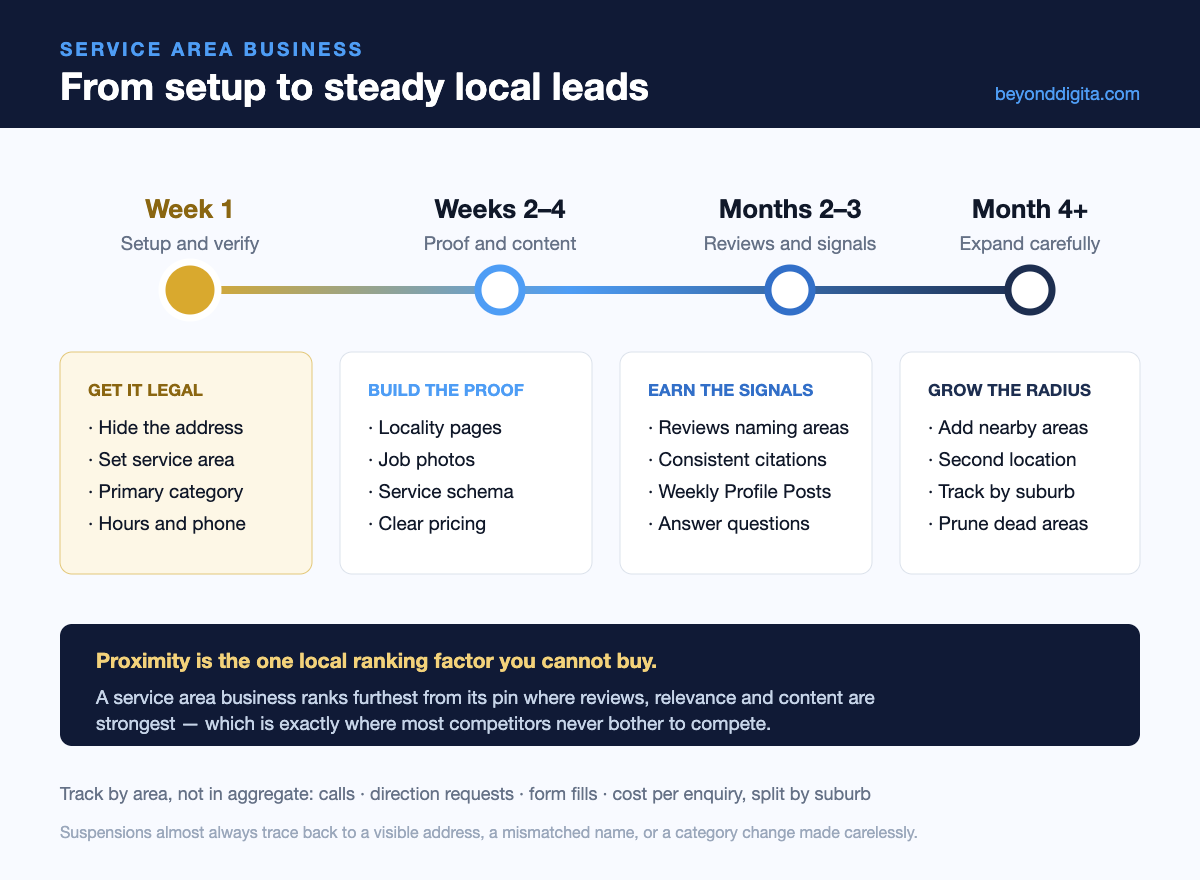
The weekly routine that keeps a profile strong
| Cadence | Action | Why it matters |
|---|---|---|
| Weekly | Publish a Profile Post about a recent job | Fresh activity and area-specific language |
| Weekly | Request reviews from that week’s customers | The only scalable source of area relevance |
| Weekly | Answer questions and reply to reviews | Engagement signals plus visible responsiveness |
| Monthly | Add job photos with genuine location context | Supports relevance and converts browsers |
| Monthly | Audit citations for NAP drift | Prevents slow erosion of trust signals |
| Quarterly | Review categories and services against demand | Catches a wrong primary category early |
None of this is difficult. It is simply relentless, which is why most competitors stop after a month — and why a disciplined service area business can out-rank far larger firms inside a single quarter. The weekly Profile Post alone is free advertising that most listings never use.
Supporting the profile from your own website
The profile is not the whole system. Google cross-checks what it says against your site, so the two must agree. Publish your service areas as readable text, not only inside a map widget. Mark up the business with structured data, using the areaServed property so the areas are machine-readable.
Make the phone number tappable and visible without scrolling. A service area business usually converts on a call, and a buried number costs more leads than any ranking position — the same principle behind landing page CRO. Where organic reach is still thin, radius-targeted ads can cover the gap while the profile matures, and the broader approach is set out in our Delhi NCR local SEO guide.
Frequently asked questions
Can a service area business rank without any address shown?
Yes. For a service area business it is the correct configuration and carries no ranking penalty. Rankings still radiate from the verified pin, so a hidden address changes what customers see, not how Google calculates.
How far can a service area business realistically rank?
Further than most owners assume, but it is earned rather than declared. Strong reviews, genuine locality content and consistent citations extend visible reach well beyond the immediate neighbourhood. An empty profile rarely ranks past a few kilometres.
Should I list every area I will travel to?
Only the ones a service area business can serve profitably. The list has no ranking effect, so over-claiming buys nothing and generates enquiries you have to turn down — which wastes time and risks poor reviews.
What do I do if my listing is suspended?
Fix the breach before appealing — usually a visible address, a stuffed name or a disallowed location. Then submit reinstatement with documentary evidence. Appealing without fixing the cause almost always fails, and repeated failed appeals make the next one harder.
Get the setup right once
Most of the damage we are asked to repair was done in the first hour of setup, then left in place for two years. A service area business that classifies itself correctly, picks the right primary category and asks for reviews every week will beat a better-funded competitor that treats the profile as a directory entry.
We run exactly this work for trades and mobile service firms across Delhi NCR as part of our local SEO service. If your profile is suspended, under-performing, or you are not sure whether it is even configured correctly, send us the listing and we will tell you what is wrong with it before you spend anything.