
Dhanteras is the single biggest buying day in the Indian calendar. Not the biggest celebrating day — that is Diwali — but the day on which the largest volume of considered purchases actually closes. Gold, vehicles, appliances, utensils, property tokens. Dhanteras marketing is therefore a different discipline from festive marketing in general, and businesses that run the same campaign across the whole season routinely miss the one window where buying intent is at its peak.
In 2026, Dhanteras falls on Friday 6 November, with Diwali on Sunday 8 November. That gives you a compressed, high-intent window rather than a long nurture runway. This guide covers what Dhanteras marketing involves in practice: what people buy, when they search, which channels convert on the day, and how to measure whether any of it worked.
If you are planning the wider season rather than the day, start with our four-week Diwali and festive marketing playbook — this article assumes that groundwork is already done and focuses on converting the Dhanteras peak itself.
Why Dhanteras marketing is not the same as Diwali marketing
Diwali demand is emotional and diffuse: gifting, decor, sweets, apparel, travel. Dhanteras demand is transactional and concentrated. The cultural belief that buying metal on Dhanteras brings prosperity converts directly into a purchase deadline, and a deadline is the most useful thing a marketer can be handed.
Three practical consequences follow. First, Dhanteras marketing rewards availability over persuasion — the buyer has already decided to buy something, and is choosing where. Second, the research window is short: most Dhanteras buyers search within 72 hours of purchasing, and a large share search on the day itself. Third, local beats national. Someone buying a gold chain or a refrigerator on Dhanteras is overwhelmingly likely to buy it near where they are standing.
That last point is why Dhanteras marketing budgets are often misallocated. Money goes into broad awareness campaigns when the decisive battle is in the Google map pack and on the business profile.
What India actually buys on Dhanteras
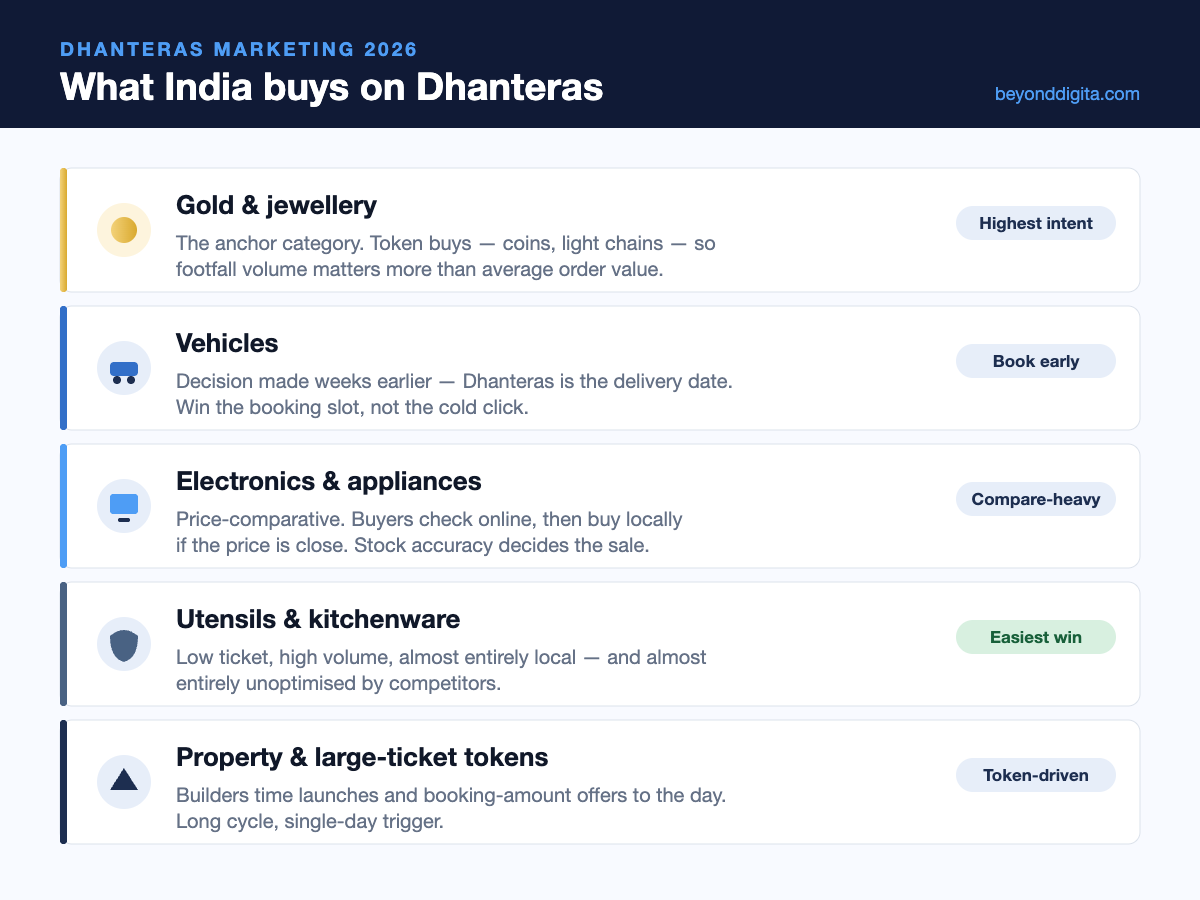
Getting the category right matters because it dictates the channel mix. Effective Dhanteras marketing for a jeweller looks nothing like the same work for an electronics retailer, and a single campaign stretched across both does neither job well.
- Gold and jewellery. The anchor category. Buyers often purchase a token quantity — a coin, a small chain — rather than a major piece, which means footfall volume matters more than average order value. Gold demand around the festive quarter is tracked in detail by the World Gold Council’s Gold Demand Trends research if you want the macro picture.
- Vehicles. Two-wheelers and cars see deliveries deliberately scheduled for Dhanteras. The purchase decision was usually made weeks earlier; Dhanteras is the delivery date. Dhanteras marketing for dealerships is therefore about booking slots in advance, not converting cold traffic. We cover this in more depth on our automotive marketing page.
- Electronics and appliances. Highly price-comparative and heavily discounted. Buyers check online, then buy locally if the price is close.
- Utensils and kitchenware. Low ticket, high volume, almost entirely local and almost entirely unoptimised by competitors — which makes it the easiest category to win.
- Property and large-ticket tokens. Builders time launches and booking-amount offers to the day. See our real estate marketing approach for how that window is worked.
The 72-hour Dhanteras marketing window
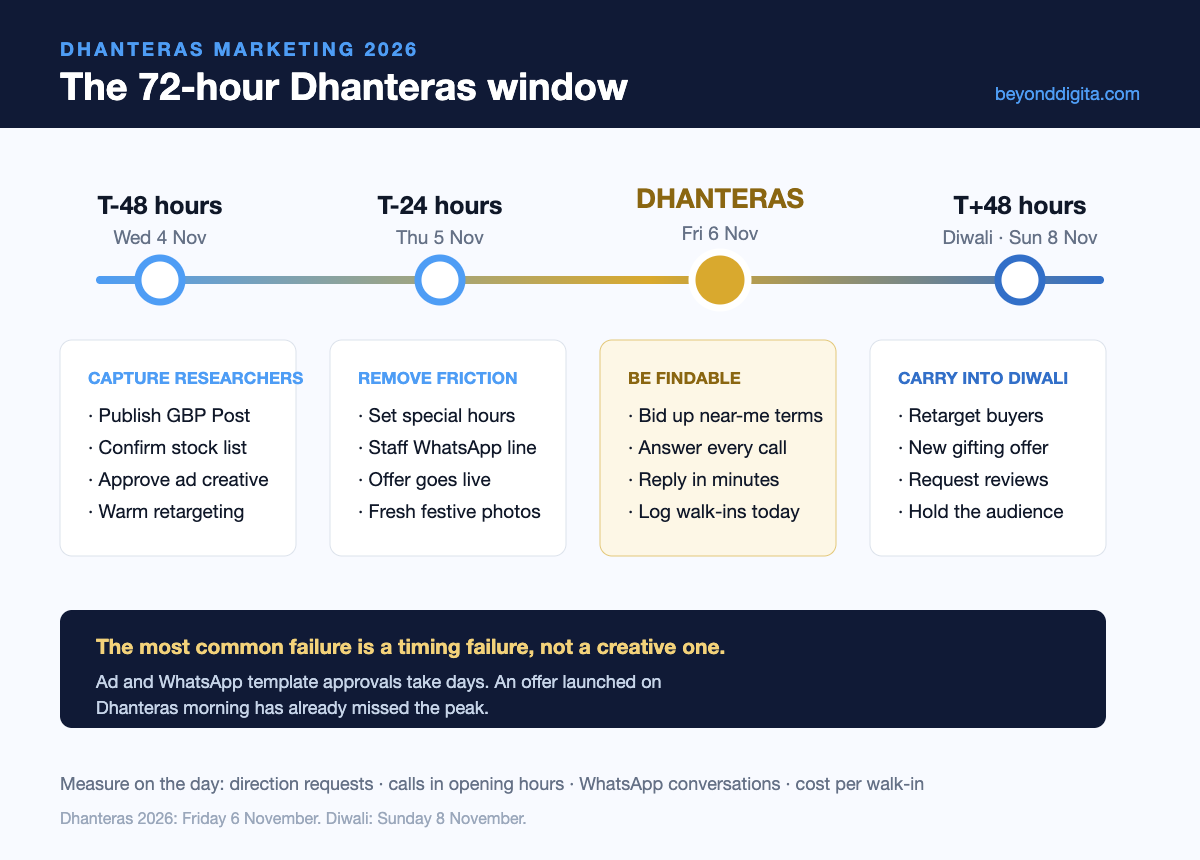
Most Dhanteras marketing failures are timing failures rather than creative failures. The offer was fine; it went live on the afternoon of Dhanteras, by which point the buyer had already walked into a competitor’s showroom.
T-48 hours: capture the researchers
Search volume for “near me” queries in buying categories starts climbing two days out. Your Dhanteras marketing priority here is making sure the business profile answers the questions a buyer has: are you open, what are the hours, is there parking, do you have stock. Publish a Google Business Profile Post with the offer — these are time-bound and well suited to a single-day event. Google documents the format in its guide to adding posts to your Business Profile, and we go deeper in our guide to Google Business Profile Posts.
T-24 hours: extend hours and say so
If you are opening early or closing late, set special hours on the profile. An incorrect “Closed” label on Dhanteras costs more than any ad you could run that day. This single step is the highest-return action available to you that week, and it costs nothing.
Dhanteras day: be findable, not clever
On the day, Dhanteras marketing is a logistics exercise. Bid up on branded and “near me” terms, make sure the phone is answered, and keep a staff member on WhatsApp. Creative experiments belong to the weeks before, not to the day demand peaks.
T+24 to T+48: carry into Diwali
Dhanteras buyers are the warmest audience you will have all year. Good Dhanteras marketing does not stop at midnight: retarget those buyers for Diwali gifting with a different offer rather than letting the spend decay.
Local search is where Dhanteras marketing is won
If you take one thing from this article: the map pack decides Dhanteras. A buyer standing in a market searching “jewellery shop near me” sees three local results above everything else, and those three capture the overwhelming majority of the clicks and direction requests.
Three profile elements carry disproportionate weight here:
- Special hours. Set them. Google explains how to edit your business hours including holiday hours in its official help documentation.
- Fresh photos. Festive stock, decorated storefront, geo-tagged, uploaded in the days before — not last year’s.
- Recent reviews. A review from last week signals an active business far more strongly than fifty from last year. Our guide on how to get more Google reviews covers the request flows that work in India.
If your profile is not ranking in your own locality, no amount of Dhanteras-specific spend fixes that in 48 hours. That is a structural problem addressed by ongoing local SEO and Google Business Profile management, and it is worth starting well before next festive season. For businesses wanting to concentrate spend tightly around a store catchment, hyperlocal ads and geofencing are the right instrument during this window.
WhatsApp: the channel that closes Dhanteras sales
Indian buyers confirm availability before travelling to a shop, and they do it on WhatsApp rather than by phone. A Dhanteras marketing plan without a staffed WhatsApp line is leaking its warmest leads.
Two things to set up: a click-to-WhatsApp ad pointing at a real person during business hours, and a catalogue or stock list that can be sent instantly. Utility and marketing message templates need pre-approval, so this is a job for the days before, not the morning of — the WhatsApp Business Platform documentation sets out the requirements. Our article on WhatsApp marketing for Indian businesses covers the pricing and spam rules in detail.
Dhanteras marketing mistakes that waste budget
- Launching the offer on the day. Approval delays on ads and message templates mean the campaign goes live after the peak has passed.
- Generic festive creative. A diya graphic with “Happy Dhanteras” and no offer, no price and no address is brand noise, not marketing.
- Ignoring stock reality. Advertising items you cannot deliver before Diwali produces cancellations and one-star reviews that outlast the festival.
- Competing on discount alone. Large chains will undercut you. Making-charge waivers, free engraving, extended warranty or same-day delivery compete better than price.
- Stopping on Diwali. Spend decays, audiences do not. The retargeting pool you built is your most valuable asset for the rest of the quarter.
How to measure Dhanteras marketing honestly
Impressions and reach tell you nothing on a single-day event. On a single-day event like this, the metrics that matter are the ones tied to a person moving toward your door:
- Direction requests from the Business Profile, measured against the same day last year.
- Calls during opening hours, not total calls.
- WhatsApp conversations started, and how many converted to a visit.
- Cost per walk-in, even if estimated — it is the only number that makes the day comparable to any other channel you run.
Record them on the day. Reconstructing single-day performance a fortnight later is guesswork, and it is the reason most businesses repeat the same Dhanteras marketing mistakes annually. If paid channels are carrying the load, our performance marketing and Google Ads management services exist to make that measurement routine rather than heroic.
Frequently asked questions about Dhanteras marketing
When should Dhanteras marketing start?
Campaign assets and audiences should be ready two to three weeks out, with the offer live 48 hours before. Ad approvals and WhatsApp template approvals both take time, and Dhanteras marketing launched on the morning of the festival has already missed most of its demand.
Is Dhanteras marketing only for jewellers?
No. Gold is the anchor category, but vehicles, electronics, appliances, utensils and property all see a measurable Dhanteras spike. Service businesses benefit too, because footfall in commercial areas rises sharply and nearby buyers are already in a spending frame of mind.
How much should a small business spend on Dhanteras marketing?
Less than most agencies suggest. Effective work here starts with a complete, accurate Google Business Profile — special hours, fresh photos, recent reviews — which costs nothing and outperforms a modest ad budget on the day. Spend on ads only once that is in place.
Do ad costs rise during Dhanteras?
Yes, sharply — auction pressure on Dhanteras marketing keywords peaks across the festive fortnight. This is why Dhanteras marketing that relies on owned channels such as the Business Profile, WhatsApp and an existing customer list delivers better returns than one built purely on paid reach.
Plan next year’s Dhanteras marketing properly
The uncomfortable truth about Dhanteras marketing is that the result is largely decided before the week begins. Profiles that rank, reviews that are current and audiences already built are what convert on the day. Everything done in the final 48 hours is execution on groundwork that either exists or does not.
If this year’s festive season exposed gaps, the right time to fix them is now, not next October. Talk to us about your local search and festive strategy and we will tell you honestly whether the gap is budget, groundwork or something else entirely.