
Most Diwali marketing plans end at the wrong moment. The budget is spent, the offer is live, the shop is full — and then Diwali passes, the ads are switched off, and the audience that just proved it buys from you is quietly abandoned. The expensive half of the season is over. The profitable half has not started.
This guide covers the two windows that get the least attention and carry the most margin: Diwali marketing on the day itself, and the thirty days that follow it. If you want the pre-season version — audience building, offer sequencing, budget pacing across four weeks — that is in our four-week Diwali and festive marketing playbook, and the single-day conversion mechanics sit in our Dhanteras marketing guide.
Every action here can be started today, with the audience and the data you already have.
Why Diwali day is not the end of your Diwali marketing
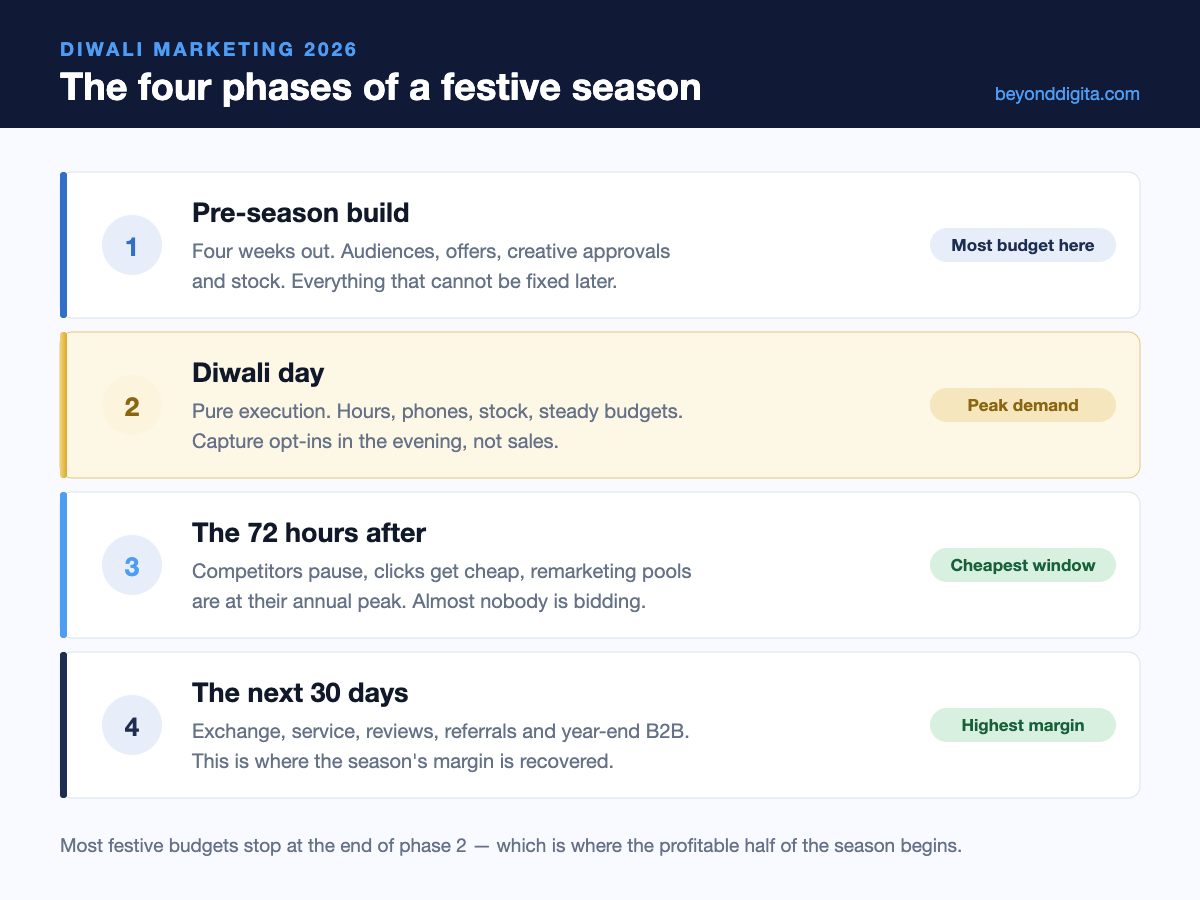
Festive demand does not switch off at midnight — it changes shape. Before the festival, people buy for the occasion: gifts, decor, sweets, the appliance that has to arrive before guests do. Afterwards the same people buy for themselves, redeem what they received, replace what broke, and spend the bonuses the season put in their hands.
That shift matters commercially because competition collapses. Through peak week, every advertiser in your category is bidding. By the Tuesday after Diwali, most of them have paused. Your Diwali marketing budget suddenly buys attention at a fraction of what it cost three days earlier, and it buys it from an audience that has already visited your site, clicked your ad, or walked into your shop.
The businesses that compound year on year treat Diwali marketing as a customer-acquisition event with a long tail, not a one-week revenue sprint. The sprint pays for the season. The tail pays for the year.
Diwali marketing on the day itself
Diwali day is not a planning day. Your Diwali marketing should already be live, and what remains is responsiveness — almost all of it operational rather than creative.
Morning: be findable and be open
Set your festive opening hours on Google so you are not shown as closed to someone standing outside. Publish a Google Business Profile Post with today’s offer and today’s closing time. Confirm your phone is answered by a person. The most common failure in Diwali marketing is not a weak creative — it is a missed call at 11am on the busiest day of the quarter.
Afternoon: hold the budget steady
Resist the urge to make changes. Mid-day edits to bids, audiences or creatives reset learning and waste the day’s most valuable hours. The only intervention worth making is raising a budget cap that is throttling a campaign already delivering. Everything else in the account should be left alone until tomorrow.
Evening: capture, don’t convert
By evening, purchase intent drops and attention moves to family. Shift the ask. Instead of pushing a sale, collect something you can use later — a WhatsApp opt-in, an email address for a post-festive offer, a follow on the page where you post. This is the cheapest list-building hour of the entire year, and most Diwali marketing plans spend it shouting about a discount nobody is still shopping for.
The 72 hours after Diwali, where most budgets go dark
The three days after the festival are the single most mispriced window in Indian Diwali marketing. Competitors have paused, cost per click falls, and your remarketing pools are at their largest of the year — full of people who looked and did not buy. Almost no festive plan budgets for it.
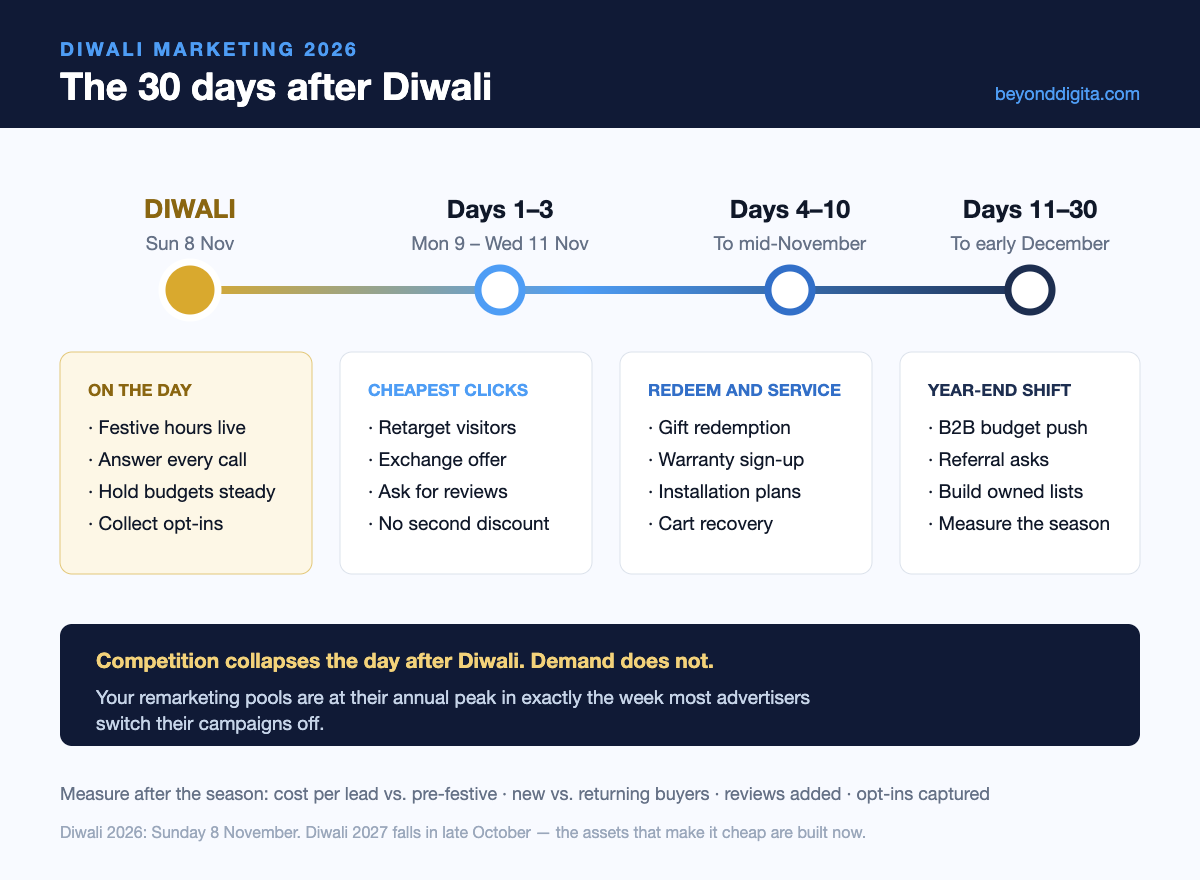
Three moves are worth making immediately. First, retarget everyone who visited in the last fourteen days with a reason to return that is not a deeper discount — extended warranty, free installation, festive service pack. Second, run an exchange or upgrade offer, which converts the appliance or phone that just got replaced. Third, ask every buyer for a review while the purchase is still fresh; the method is in our guide on how to get more Google reviews.
Reviews collected in this window do more for your Diwali marketing next year than any creative you could produce. They land during your highest-volume month, they lift map pack visibility for months afterwards, and they cost nothing but the asking.
Diwali marketing ideas that work in the 30 days after
These are the plays we run for clients once peak week closes, ordered by how quickly they return money.
| Play | Who it targets | Why it works now |
|---|---|---|
| Gift-redemption offer | Recipients, not buyers | A whole audience that owns your product but has never been your customer |
| Exchange and upgrade | Anyone who just replaced an item | Highest-margin conversion of the season, zero discount needed |
| Service and installation | Peak-week purchasers | Recurring revenue attached to a one-time sale |
| Abandoned-cart recovery | Peak-week non-buyers | Intent is proven; only the urgency has gone |
| Year-end and GST-cycle push | B2B and professional buyers | Budgets must be spent before the financial year closes |
| Review and referral request | Every buyer | Compounds into next year’s organic visibility |
The gift-redemption play is the one most businesses miss entirely. Every product you sold in October was, in many cases, given to somebody else. That person now owns your brand, has never bought from you, and is not in any of your audiences. Building Diwali marketing around registration, warranty activation or a first-service booking turns them into a contactable customer for the price of one campaign.
Diwali marketing by category: what to push after the festival
Retail and electronics
Lead with exchange, extended warranty and accessories. Accessory attachment is the fastest margin recovery available after a discount-heavy peak, and it needs no new creative — only a changed headline on an existing landing page.
Services and home improvement
Demand rises after Diwali, not before. Homes have been cleaned, faults have been noticed, and guests have left. Shift Diwali marketing spend into repair, servicing and renovation terms, supported by hyperlocal ads and radius targeting around the neighbourhoods that converted during the season.
Automotive and large-ticket
Bookings made during the festive period deliver over the following weeks, so keep the enquiry funnel running rather than switching it off, and move budget from awareness into the booking and test-drive terms that close.
B2B and professional services
Ignore the festive angle entirely and run the year-end one. From mid-November, unspent budgets and the approaching financial year close drive more enquiries than any festive creative. This is where Diwali marketing for B2B quietly outperforms the consumer version.
How to measure whether your Diwali marketing worked
Revenue alone will not tell you whether your Diwali marketing worked, because the season inflates everything. Measure against the month before, not against last Diwali — and judge every channel on cost per acquisition rather than top line.
| Metric | What it tells you |
|---|---|
| Cost per lead, festive vs. pre-festive | Whether you paid a fair premium or overbid |
| New vs. returning buyers | Whether the season acquired customers or just pulled existing demand forward |
| Remarketing pool growth | The asset you carry into the next 30 days |
| Reviews added during the season | Your compounding local visibility gain |
| Opt-ins captured | Owned audience you no longer have to rent |
| Repeat purchase rate at 60 days | Whether festive buyers were customers or bargain hunters |
Set these up as GA4 audiences and comparisons before the data ages, using the approach in our guide to GA4 and AI insights. A season you cannot measure is a season you will repeat identically next year, including the parts that lost money. Honest post-season measurement is the cheapest improvement available to any festive programme.
Diwali marketing mistakes we see every year
- Ending Diwali marketing on 9 November. The cheapest clicks of the quarter are in the week you stopped bidding.
- Discounting twice. A second markdown after Diwali trains customers to wait. Add value instead — service, warranty, installation.
- Never asking for the review. Thousands of transactions, no reviews, and the same weak map pack position when Diwali marketing starts again next year.
- Letting the audience expire. Remarketing lists have windows. Build an owned list through email automation flows and WhatsApp opt-ins before they lapse.
- Judging the season on revenue alone. Festive revenue rises even when the campaign was inefficient. Margin and cost per acquisition are the real scoreboard.
- Starting next year in September. The audiences and reviews that make next Diwali cheap are built in the next four weeks.
Planning Diwali marketing for 2027
Diwali 2027 falls in late October. That is roughly fifty weeks away, and almost everything that will determine what next year costs you is built now, not in the eight weeks before.
Three assets do the work. Reviews, which take months to accumulate and lift local SEO visibility across every query you compete for. Owned audiences — email and WhatsApp lists you can reach without paying for reach. And content that is already indexed and ranking, because a page published in October has no chance of ranking in November. The honest truth about Diwali marketing content is that it has to exist nine months before the season to earn anything from search.
Everything else — creative, offers, budget, bids — is a decision you can make in a week. Those three assets are not. Building them in the fortnight after Diwali is the highest-return Diwali marketing decision available to a business of any size, and the one almost nobody makes.
Frequently asked questions
When should Diwali marketing actually stop?
Around thirty days after Diwali, when remarketing pools thin out and year-end messaging takes over. Stopping on Diwali night abandons the cheapest and highest-intent window of the season.
Are ads cheaper after Diwali?
Usually, yes. Auction pressure falls sharply once competitors pause festive campaigns, while your own remarketing audiences are at their annual peak. Lower competition against a warmer audience is the most favourable combination you will see all year.
Should I discount again after Diwali?
Rarely. A second discount erodes margin and teaches buyers to wait out your pricing. Added value converts almost as well and protects what the season earned — this is the clearest difference between Diwali marketing that builds a business and the kind that only moves stock.
What is the one thing to do this week?
Ask every festive buyer for a review, and capture a WhatsApp or email opt-in while they still remember buying from you. It costs nothing and it is the only part of Diwali marketing that still pays you next October.
Make next Diwali cheaper than this one
We plan, run and measure festive campaigns for businesses across Delhi NCR, and the work that matters starts in the weeks after the season rather than the weeks before it. If you want the next thirty days structured properly — retargeting, review generation, owned-audience capture and a measured read on what this season actually cost you — our performance marketing team can take it from here.
Talk to us about your post-festive plan, and we will tell you honestly whether your Diwali marketing is worth extending or worth rebuilding for 2027.