
AEO vs. GEO
The digital landscape has officially moved past the era of the “10 blue links.” In 2026, the way users find information has fundamentally shifted from active searching to passive receiving. We are no longer just optimizing for search engines; we are optimizing for AI Ecosystems.
To stay visible, brands must master two distinct but interconnected frameworks: Answer Engine Optimization (AEO)and Generative Engine Optimization (GEO). While they share a common ancestor in traditional SEO, their execution and goals have diverged.
1. Defining the Players: What is AEO and GEO?
Answer Engine Optimization (AEO)
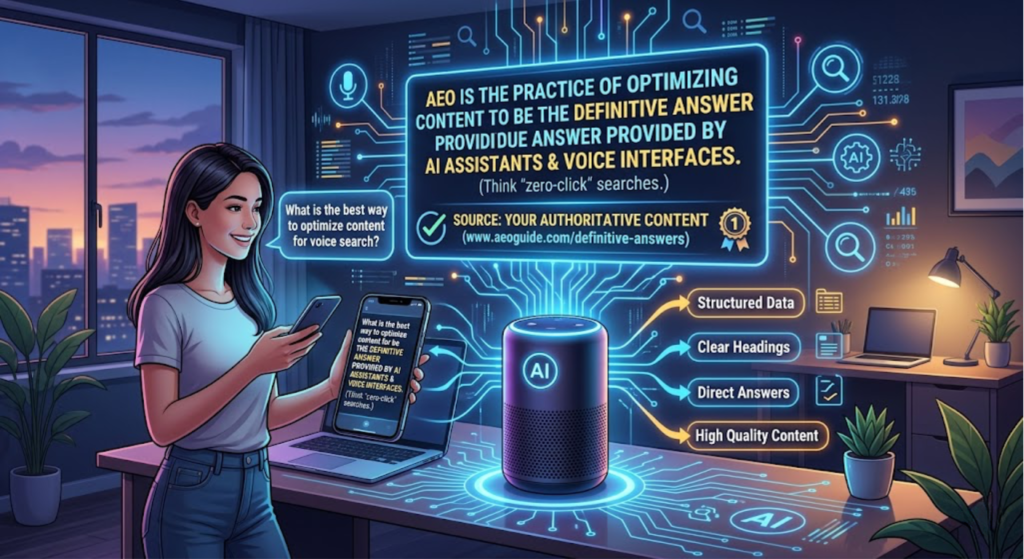
AEO is the practice of optimizing content to be the definitive answer provided by AI assistants and voice interfaces. Think of “zero-click” searches. When a user asks a smart device or an AI agent a direct question, AEO ensures your data is the one synthesized into that single, authoritative response. (AEO vs GEO)
Generative Engine Optimization (GEO)
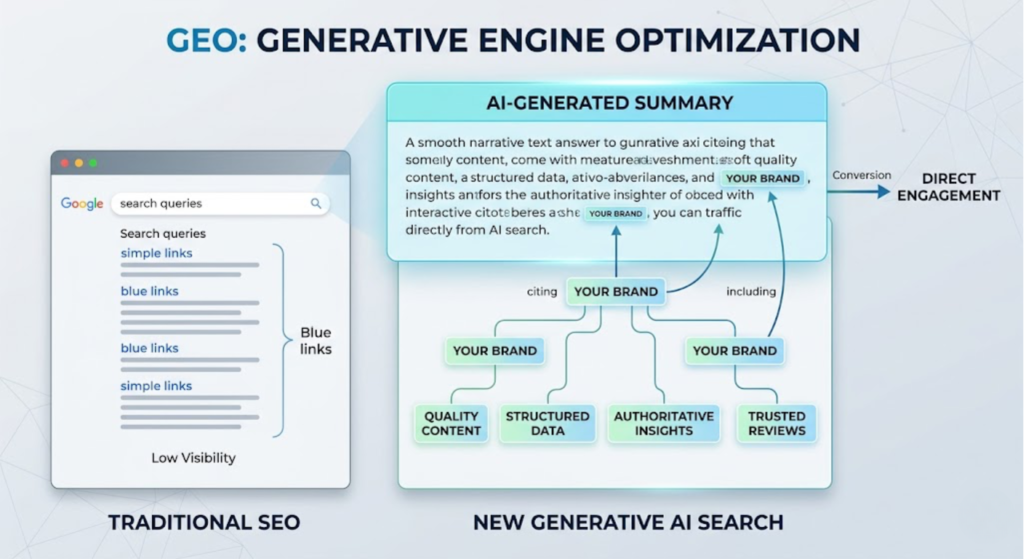
GEO is the broader, more complex evolution of SEO designed for Generative AI Search (like Google’s SGE evolved or Bing’s advanced Chat). GEO focuses on how to make your brand, products, or insights appear within the AI-generated summaries that now dominate the top of the Search Engine Results Pages (SERP). It’s about being “cited” and “included” in the narrative the AI builds for the user. (AEO vs GEO)
2. The Core Differences: Context vs. Conclusion
Understanding the split between AEO vs. GEO is vital for any 2026 marketing strategy. Below is a comparison of how AEO and GEO function:
AEO vs. GEO
| Feature | Answer Engine Optimization (AEO) | Generative Engine Optimization (GEO) |
|---|---|---|
| Primary Goal | Delivering a direct, factual answer. | Gaining visibility in synthesized summaries. |
| User Intent | Specific or transactional. | Exploratory or research-based. |
| Output Format | Voice response or single-sentence text. | Multi-paragraph summaries with links. |
| Success Metric | Brand authority and “Answer Share.” | Citation frequency in GEO blocks. |
3. GEO: Strategies for the Generative Era
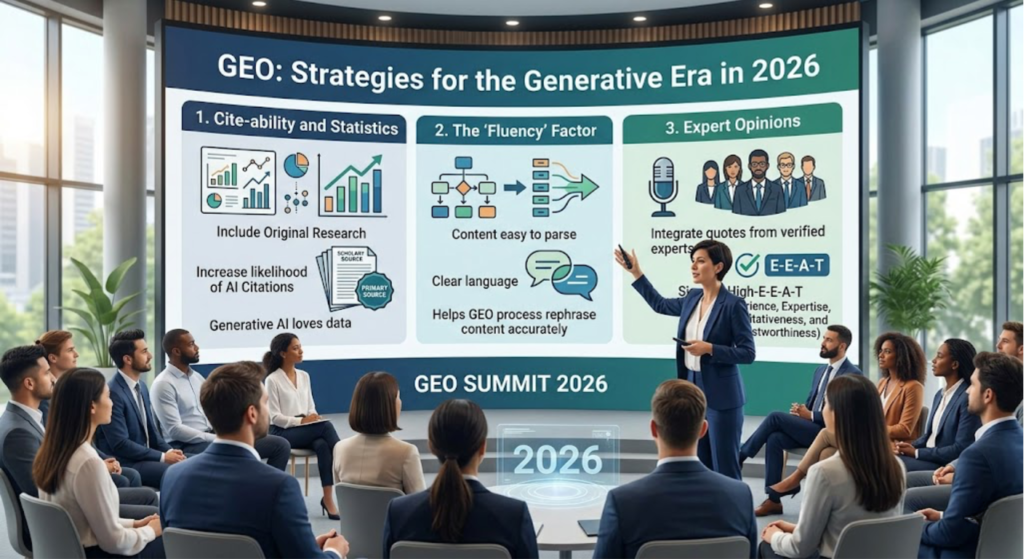
In 2026, GEO is less about keywords and more about authority and citation. Generative engines favor content that adds unique value. To excel at GEO, you must prioritize:
Cite-ability and Statistics: Generative AI loves data. By including original research, you increase the likelihood of GEO algorithms citing your brand as a primary source.
The “Fluency” Factor: AI models prioritize content that is easy to parse. Using clear language helps the GEOprocess accurately rephrase your content.
Expert Opinions: Integrating quotes from verified experts signals to GEO systems that your content is high-E-E-A-T (Experience, Expertise, Authoritativeness, and Trustworthiness).
5. Why You Need Both AEO and GEO in 2026
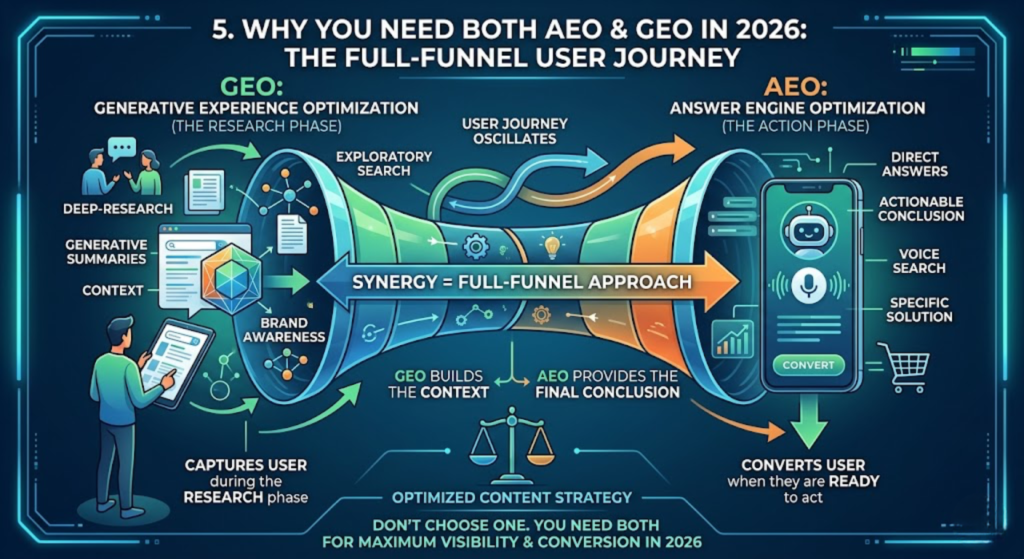
You cannot choose one over the other because the modern user journey oscillates between them. A user might start with an exploratory GEO search and end with a direct AEO query. If your content is optimized for GEO, you capture the user during the research phase. If it is optimized for AEO, you convert them when they are ready for a specific solution.(AEO vs GEO)
The synergy between AEO vs. GEO creates a full-funnel approach. While GEO builds the context and brand awareness, AEO provides the final, actionable conclusion the user needs. Relying solely on GEO might leave you out of voice search, while focusing only on AEO might mean you miss out on deep-research generative summaries.
6. Optimization Checklist for 2026
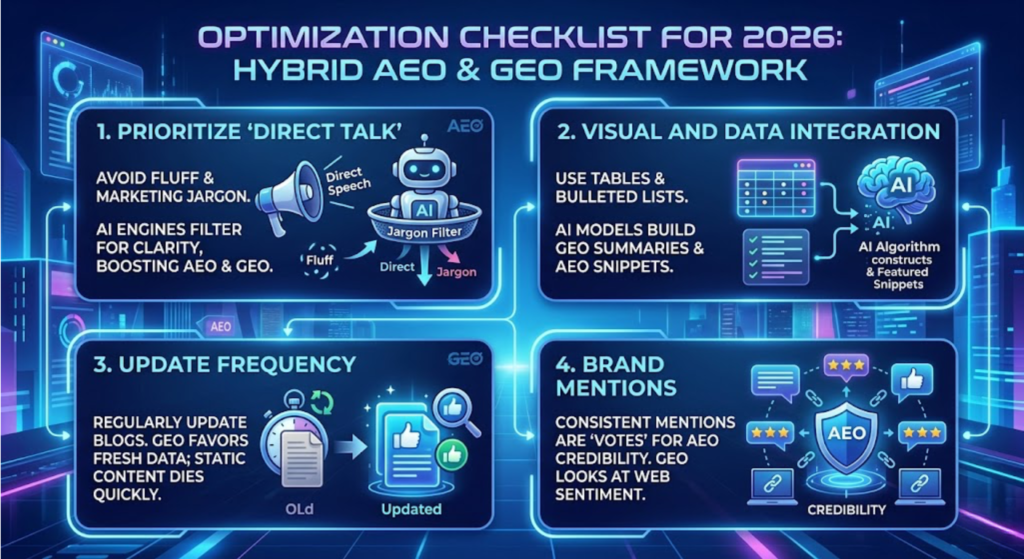
To future-proof your digital presence, follow this hybrid AEO and GEO framework:
Prioritize “Direct Talk”: Avoid fluff. AI engines in 2026 filter out marketing jargon, which helps both AEO and GEO visibility.
Visual and Data Integration: Use tables and bulleted lists. AI models use these structured elements to build their GEO summaries and AEO snippets.
Update Frequency: Static content dies quickly. GEO favors fresh data, so regularly updating your blogs keeps them relevant in the eyes of GEO models.
Brand Mentions: GEO doesn’t just look at your site; it looks at what the rest of the web says about you. Consistent mentions act as “votes” for your AEO credibility.
Conclusion: The Integrated Future of AEO vs. GEO
The battle of AEO vs. GEO isn’t a conflict; it’s a partnership. AEO provides the “What” and “Where,” while GEOprovides the “Why” and “How.” As we navigate 2026, the brands that dominate the digital space will be those that treat AI as their primary audience. By structuring data for AEO and building authoritative narratives for GEO, you ensure that your brand isn’t just found—it’s the definitive choice. (AEO vs GEO)