
Let’s be honest — we saw this coming for years. The death of third party cookies was always looming on the horizon, and in 2026, it’s no longer a “someday” problem. It’s Tuesday. And if your marketing strategy still leans on third party cookies to track and target your audience, you’re already falling behind.
But here’s the thing: this isn’t a disaster. It’s a reset.
The Moment Everything Changed
To understand where we are, you have to go back to what quietly broke everything: Google’s “Global Consent Prompt.”
Rather than pulling a technical kill switch on third party cookies outright, Google did something more interesting — and more devastating for advertisers. They simply asked users to choose. Opt in or opt out. A clear button, plain language, no dark patterns.
People said no. Almost universally.
It shouldn’t have surprised anyone. When you give people a genuine choice about whether to be tracked across the internet, most of them take the exit door. We saw the same thing happen when Apple introduced App Tracking Transparency. Turns out, people don’t love being followed around the web. Who knew?
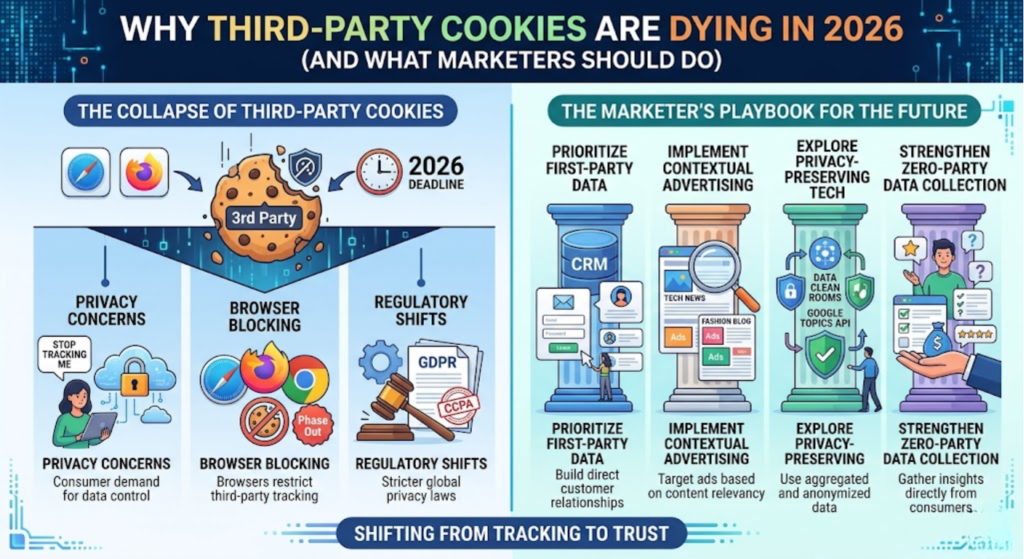
On top of that, regulations have teeth now. GDPR has been around for years, but the EU AI Act of 2026 has regulators moving with real urgency. Data protection fines aren’t symbolic anymore — they’re business-ending. The combination of technical failure and legal exposure has made third party cookies less of a “gray area” and more of a ticking clock. Any brand still dependent on them is sitting on a legal liability they can’t afford to ignore.
So What Are We Actually Using Now?
The good news is that the industry didn’t just shrug and give up. Smart people have been building alternatives, and they share one common thread: they’re designed around privacy from the ground up, not bolted on as an afterthought. Because third party cookies were never built with consent in mind, every replacement is fundamentally different in philosophy.
A few of the most promising approaches:
Privacy Sandboxes — Browser-level tools that can still serve interest-based ads without ever handing over your identity. You’re a “person who likes hiking,” not “Sarah, 34, from Austin.”
Contextual Advertising — This one’s almost charmingly old-school. Show hiking boot ads on hiking websites. Show recipe ads on cooking blogs. Match the message to the moment, not the person. It works, and it always did.
Zero-Party Data — This is the gold standard right now. It’s information your customer chose to give you — filling out a preference form, answering a quiz, telling you what they’re actually interested in. No inference, no guessing. Just a direct conversation.
What You Should Actually Do Right Now
If you’re a marketer staring at your 2026 strategy wondering where to start, here’s the honest truth: there’s no single magic replacement for third party cookies. The cookieless world requires a portfolio approach. But there are a few moves worth making immediately.
Own your data. First-party data — the stuff you’ve collected directly through your own channels — is now your most valuable marketing asset. Protect it, enrich it, and build your strategy around it. Focus on “value exchanges”: give people a real reason to share their information with you. A discount, early access, a personalized experience. Make it worth their while.
Explore Data Clean Rooms. These allow you and a partner to match your datasets in a secure, encrypted environment — neither party ever sees the other’s raw data, but you can find meaningful overlaps. It sounds technical, and it is, but the payoff in reach and precision is real.
Revisit Marketing Mix Modeling. Attribution in the old sense — tracking a single customer from click to purchase — is increasingly difficult without third party cookies. MMM takes a step back and looks at the whole picture statistically: how your TV spend, your paid social, your email campaigns all work together to drive revenue. It’s less granular, but it’s honest, and right now, honest is valuable.
Move tracking server-side. Instead of relying on browser-based scripts that are increasingly blocked or restricted, move your tracking infrastructure to your own servers. You get better data quality, better site performance, and far more control over what’s collected and why — all without touching third party cookies at all.
Here’s the Part No One Talks About
Yes, this transition is hard. Yes, performance metrics are going to look different for a while, and some campaigns that used to “just work” won’t anymore. That’s real, and it’s okay to acknowledge it.
But there’s something on the other side of this that’s genuinely worth reaching for.
For years, digital advertising had a reputation problem. People felt surveilled. They’d search for a toaster once and see toaster ads for six weeks. That’s not marketing — that’s being haunted. It eroded trust between brands and the people they were trying to reach, and that erosion had a cost that never showed up in attribution reports. Much of that damage traces directly back to third party cookies operating invisibly in the background.
The privacy-first era is a chance to fix that. When the data you have is data people actually chose to share with you, it’s cleaner, more accurate, and more meaningful. When your targeting is based on context and consent rather than hidden tracking, your brand isn’t something people are trying to escape — it’s something they might actually welcome.
The Bottom Line
The era of third party cookies is over. Not mostly over, not fading — over. Brands that spend 2026 trying to patch the old system together will waste time, money, and goodwill. The ones that lean into first-party relationships, privacy-safe technologies, and honest value exchanges will come out of this stronger.
It’s a harder road in the short term. But the destination — a marketing practice built on trust rather than surveillance — is one worth walking toward.