

A lot of Indian business sites still carry FAQ schema that was added to win a rich result Google no longer shows them. The markup is not harmful, but the reason it was added has quietly expired, and plenty of agencies are still selling it on the old promise.
This guide covers what actually changed, whether FAQ schema and HowTo markup are still worth implementing, and where structured data effort now pays back instead. Our broader schema markup guide covers the types that still display.
What Google actually changed
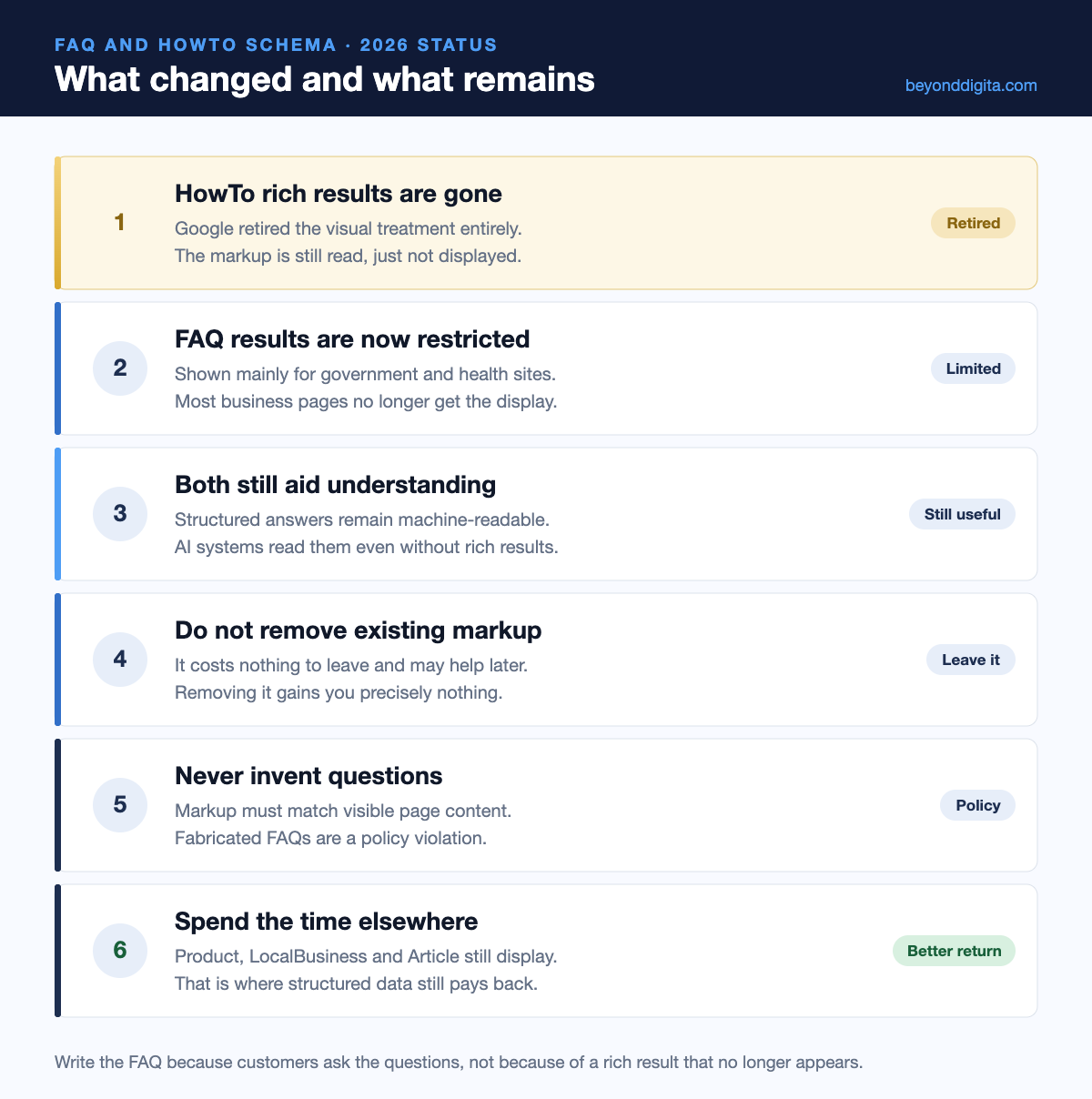
Google made two announcements about FAQ schema and HowTo that most businesses never heard about. HowTo rich results were retired entirely — the step-by-step visual treatment in search results simply stopped appearing. And FAQ schema display was restricted to a narrow set of authoritative sites, principally government and health domains.
Google documented both in its announcement on FAQ and HowTo changes. The practical effect for a Delhi clinic, a coaching centre or a D2C brand is that adding FAQ schema today will almost certainly not produce the expanded result you were shown in a proposal deck.
That is worth stating plainly, because it is still being sold. If an agency proposes FAQ schema as a way to “take up more space in search results”, that pitch is several years out of date.
So is it still worth doing?
Yes, FAQ schema is still worth adding, but for a different reason and at much lower priority than before.
| Reason | Still valid? | Notes |
|---|---|---|
| Expanded rich result | No | Restricted to a narrow set of sites |
| More space in SERPs | No | The display no longer appears |
| Machine-readable answers | Yes | AI systems still parse the structure |
| Voice and assistant answers | Partly | Clear structure helps regardless of markup |
| Forces better page content | Yes | The underlying discipline is genuinely useful |
The third row is the real argument now. FAQ schema makes your answers unambiguous to systems that summarise rather than list — and those systems are increasingly where people encounter your business first.
The fifth row is the underrated one. Writing a proper FAQ forces you to answer the questions customers actually ask, which improves the page whether or not any markup is attached to it.
Do not remove what you already have
A common overreaction is stripping existing FAQ schema out. There is no benefit in doing so.
Valid FAQ schema costs nothing to leave in place, is still read by crawlers and language models, and Google has reversed display decisions before. Removing it is work that gains you precisely nothing and might cost you later.
The one case for removal is markup that does not match the page — fabricated questions, or an FAQ block that no longer appears in the visible content. That is a policy problem rather than a display problem, and it should be fixed either way.
Where to spend the effort instead
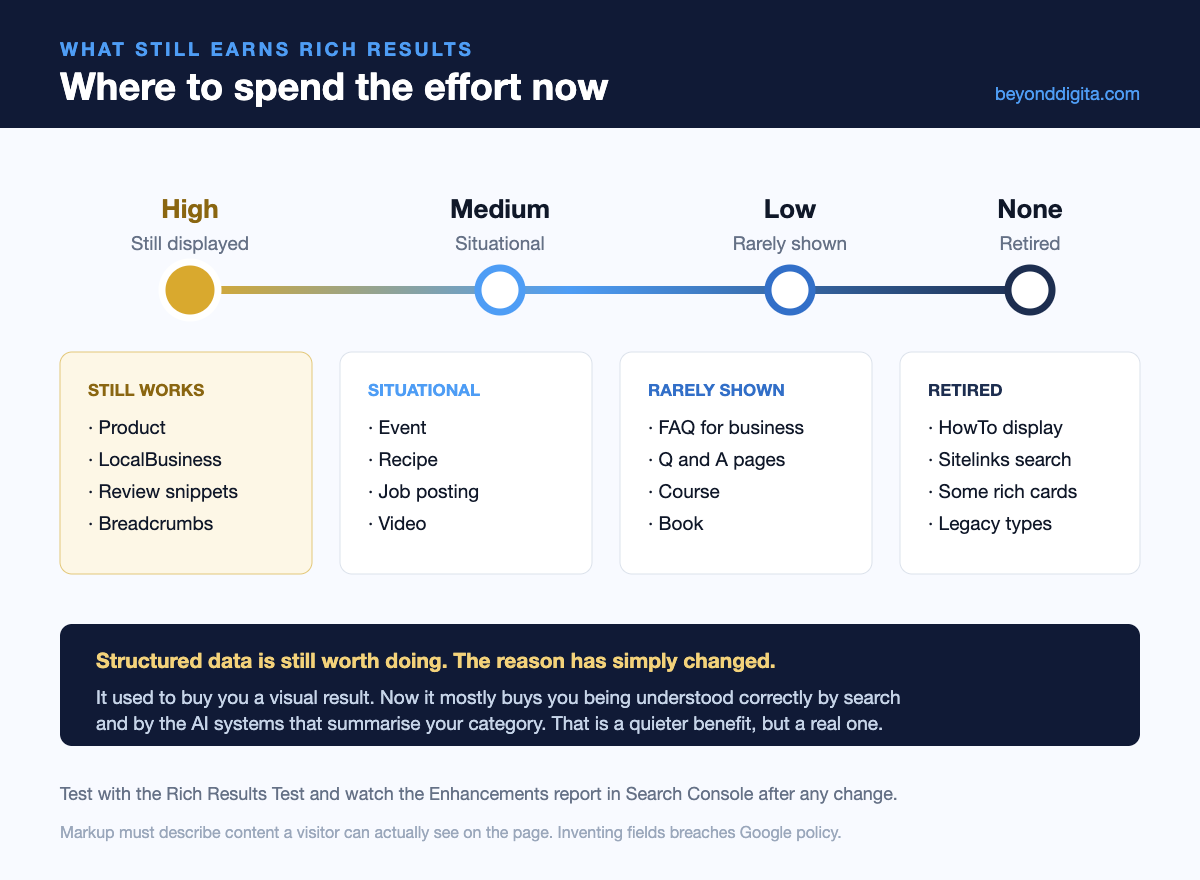
If you have a developer’s time and want visible returns, these beat FAQ schema comfortably.
- Product. Price, availability and ratings still appear in results and lift click-through immediately. See our guide to product page SEO.
- LocalBusiness. Foundational for any local business, and increasingly how assistants decide whether to mention you — covered in our LocalBusiness schema guide.
- Breadcrumbs. Small, reliable, still shown, and trivial to implement correctly — unlike content pruning, which needs judgement.
- Review snippets from genuine on-site reviews only.
- Event, Recipe, Job Posting where relevant to your business. All still display.
- Article for publishers and blogs, supporting Discover and Top Stories.
Each of those produces something visible, which FAQ schema no longer does for most sites. If structured data time is limited, this is the honest order of priority.
How to write an FAQ that earns its place
Since the SEO case for FAQ schema has weakened, the content reason has to carry it — and that is a higher bar than most FAQ sections clear.
Use real questions. Your sales calls, WhatsApp messages and the Questions section of your Google Business Profile are full of them. “What are your prices?”, “Do you come to Noida?”, “How long does it take?” are worth answering. Invented questions beginning “Why choose us for…” are not, and marking them up with FAQ schema does not improve them.
Answer in two or three sentences, directly, without a sales pitch in the first line. Include the uncomfortable answers — price ranges, what you do not do, how long things really take. Those are the ones people are looking for, and they are what gets quoted when a model summarises your page.
Where the questions should come from
The hardest part of useful FAQ schema is not the markup. It is finding questions people genuinely ask rather than questions you wish they asked.
| Source | What you get | Effort |
|---|---|---|
| Your own WhatsApp and call logs | The real objections, in customer words | An hour |
| Google Business Profile questions | Public questions about your business | Ten minutes |
| Search Console queries | Question phrases you already receive | Twenty minutes |
| Sales team notes | What stops people buying | One conversation |
| Competitor review complaints | Fears you can address directly | Thirty minutes |
The first row is the richest and the one nobody uses. An hour reading your own WhatsApp enquiries will produce better FAQ schema content than any keyword tool, because it contains the exact phrasing of real doubt.
Your Business Profile questions are worth checking for a second reason: anyone can answer them, including competitors and people guessing. Reviewing and answering them yourself is part of good profile management, and those answers feed the same understanding that structured markup is meant to support.
Implementation, if you proceed
| Rule | Why |
|---|---|
| Questions must be visible on the page | Markup describes content, not intentions |
| One FAQ block per page | Duplicates confuse rather than reinforce |
| No promotional answers | Against guidelines and reads badly |
| Keep answers under 100 words | Longer answers are rarely used |
| Validate after every site change | Plugins and themes break markup routinely |
Test with Google’s Rich Results Test and the Schema.org validator. The first tells you what Google can use; the second tells you whether the markup is technically valid, which are different questions. Google’s FAQPage documentation sets out the current requirements.
A working example
If you are implementing it anyway, here is a correct block for a service business. Place it as an application/ld+json script on the page whose visible content it describes.
{
  "@context": "https://schema.org",
  "@type": "FAQPage",
  "mainEntity": [{
    "@type": "Question",
    "name": "Do you cover Noida and Ghaziabad?",
    "acceptedAnswer": {
      "@type": "Answer",
      "text": "Yes. We cover all of Delhi NCR including Noida, Greater Noida, Ghaziabad, Gurugram and Faridabad, with no travel charge inside a 15km radius."
    }
  }, {
    "@type": "Question",
    "name": "How long does a typical project take?",
    "acceptedAnswer": {
      "@type": "Answer",
      "text": "Most projects take four to six weeks from approval. Larger builds run eight to twelve weeks, and we confirm the timeline in writing before starting."
    }
  }]
}
Two things to notice. Both questions are ones a real customer asks, and both answers contain specifics rather than reassurance. That is the difference between FAQ schema that earns its place and filler.
The answers must also appear in the visible page content, word for word or close to it. Markup describing text a visitor cannot see breaches Google’s spam policies, regardless of whether a rich result is involved.
What this tells you about SEO advice generally
There is a wider lesson in the FAQ schema story, and it is worth more than the markup itself.
A tactic worked, it was widely sold, Google changed the rules, and the selling continued unchanged for years afterwards. The same pattern applies to directory submissions, to keyword density targets, and to several things still appearing in proposals today.
The defence is simple: ask what visible outcome a tactic produces, and ask when the person last verified it. An agency recommending FAQ schema for rich results in 2026 has not checked since 2022, and that tells you something about everything else in the proposal — the same test we apply when comparing quotes.
Frequently asked questions
Will FAQ rich results come back?
Nobody outside Google knows. Display decisions have been reversed before, which is an argument for leaving existing markup alone rather than for adding more.
Does FAQ schema help with AI answers?
Plausibly, though nobody can prove it from outside. Clear question-and-answer structure is easy for a model to parse, with or without markup — see our work on answer engine optimisation.
Should I still use HowTo markup?
Only if you already have it, and the same reasoning applies as for FAQ schema. There is no display benefit now, so new implementation is hard to justify against page speed work that still matters.
My agency is charging for FAQ schema. Is that fair?
It is fair as part of writing good page content. It is not fair if sold as a route to expanded search results, because that outcome is no longer available to most sites.
Write the FAQ, keep the markup, lower the expectations
The short version: write FAQs because your customers ask those questions, add FAQ schema because it costs ten minutes and may help machines understand you, and stop expecting it to change how your result looks.
If someone has quoted you for structured data work, send us the proposal — our SEO team and local SEO team will tell you which parts still produce something visible and which are being sold on a promise that expired.