
Google’s automated campaign types promise to find your customers for you. They often do. What they cannot do is invent customers who were never looking, and that single limitation is why a demand-led strategy matters more with AI Max and Performance Max than it did with manual campaigns.
A demand-led strategy treats automation as a multiplier. Point it at genuine demand with clean signals and it works extremely well. Point it at a market that does not exist, or feed it the wrong conversion, and it will spend your budget with great confidence and no result. Our comparison of Performance Max, AI Max and Demand Gen covers which to use where.
What demand-led actually means
A demand-led strategy starts from the question: is anybody already looking for this? Not would they want it, not is it a good product — is there measurable search behaviour happening right now that a campaign could capture.
The opposite approach, which is more common than it should be, starts from the budget and the product and assumes the channel will find buyers. For manual search campaigns that assumption failed visibly — you saw the search terms, you saw the zero impressions, and you adjusted. Automation hides that failure behind busy-looking dashboards.
This is why a demand-led strategy has become a prerequisite rather than a preference. Performance Max will always find somewhere to spend money. Whether that somewhere contains buyers is a question only you can answer before you switch it on.
How to prove demand exists first
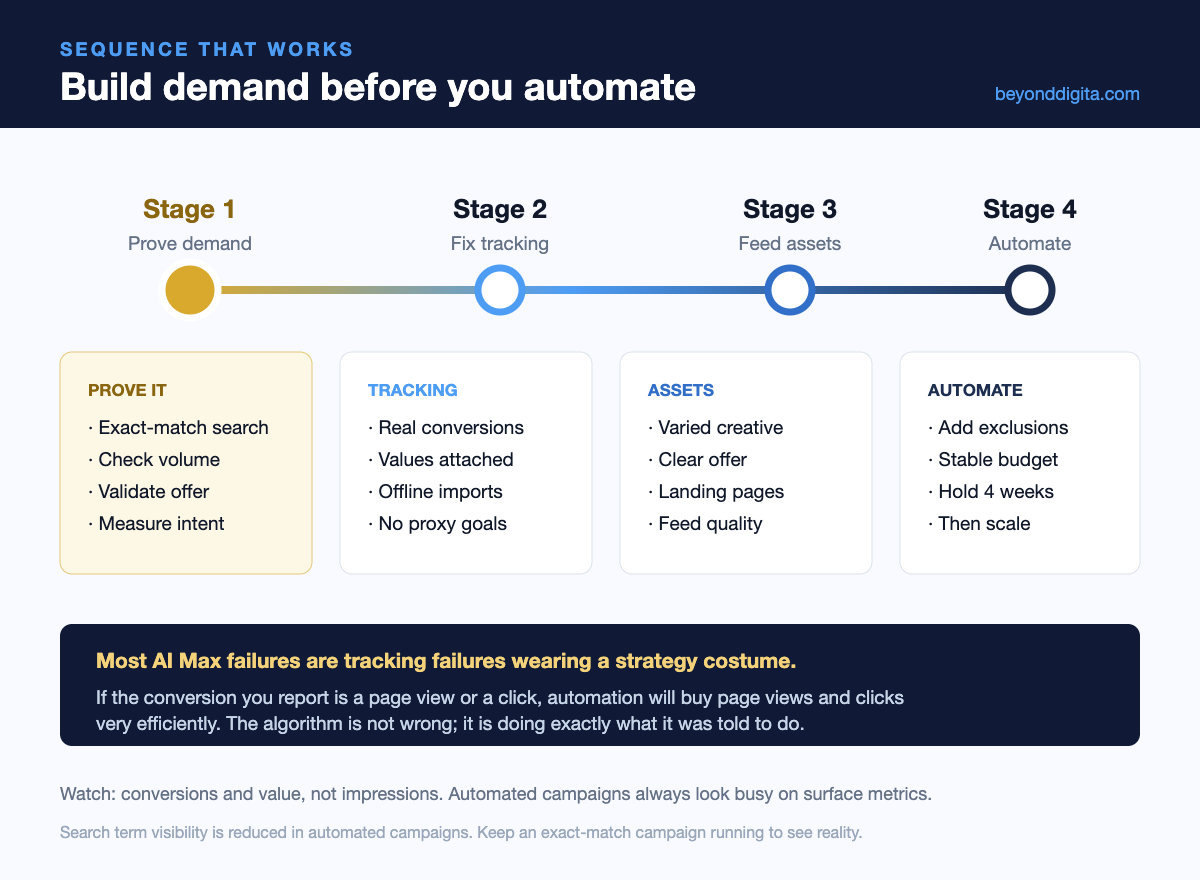
A demand-led strategy starts with a small exact-match search campaign on the terms you believe describe your buyers. It is deliberately unglamorous and it answers the only question that matters.
| What you see | What it means | Next step |
|---|---|---|
| Volume and conversions | Demand exists and converts | Automate confidently |
| Volume, no conversions | Demand exists, offer or page fails | Fix the page first |
| Low volume, good conversion | Narrow but real market | Stay manual, expand slowly |
| No volume at all | Nothing to amplify | Build demand elsewhere |
That bottom row is where a demand-led strategy saves the most money. If nobody is searching, no automated campaign will rescue it — the answer is social, content or outreach to create awareness first, not a larger Google budget.
The second row catches almost as many businesses. Traffic arriving and not converting is a landing page problem, and automation will simply find more people to bounce.
Conversion signals are the whole game
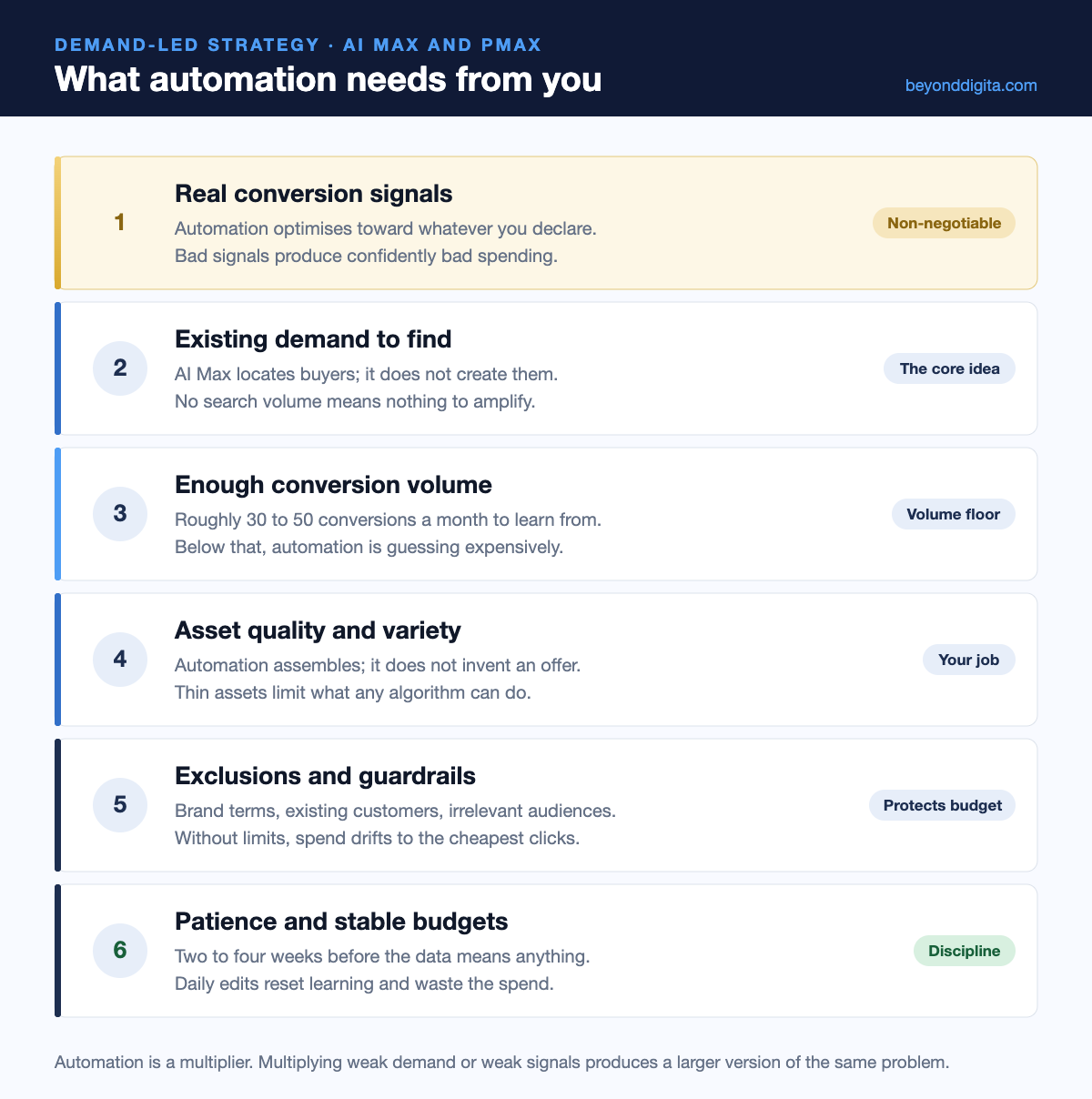
Automated campaigns optimise toward the conversion you declare, which makes signal quality the foundation of any demand-led strategy. If you declare the wrong thing, they will pursue it relentlessly and efficiently.
We regularly audit accounts where “conversion” means a page view, a click on a phone number regardless of whether the call connected, or a form submission including obvious spam. The algorithm then optimises for the cheapest source of those events. It is not malfunctioning; it is doing exactly what a demand-led strategy would have caught before launch.
Fix this before anything else. Declare only conversions that represent real business value, attach values where you can, and import offline outcomes if your sales close on the phone. Google’s conversion tracking documentation covers the mechanics, and our guide to first-party data covers feeding real outcomes back in.
What a demand-led strategy looks like in practice
Here is how the same budget gets deployed under two approaches, for a Delhi business spending roughly ₹60,000 a month on Google.
| Month | Budget-led approach | Demand-led approach |
|---|---|---|
| 1 | Launch PMax at full budget | ₹15,000 exact-match test, fix tracking |
| 2 | Results erratic, edits daily | ₹30,000 on proven terms, build assets |
| 3 | Pause, blame the channel | Introduce automation with exclusions |
| 4 | Restart from scratch | Scale what already converts |
The budget-led column is not a caricature. It is the most common pattern we inherit, and the business usually concludes that Google Ads does not work for its category. A demand-led strategy reaches month four with evidence instead of a theory.
The cost difference matters too. Spending ₹15,000 to learn that demand is thin is a cheap answer. Spending ₹2,40,000 across four months to reach the same conclusion is not, and that gap is the entire practical argument for sequencing.
Assets are your side of the bargain
Automated campaigns assemble combinations from what you supply. They do not write a better offer, photograph a better product or invent a reason to choose you.
Thin asset groups are a quiet cause of poor performance. Three headlines and one image gives the system almost nothing to test, so it settles early on a mediocre combination. Variety in message, not just in wording, is what a demand-led strategy supplies — different angles on why someone should act, so the algorithm can discover which actually resonates.
For ecommerce the equivalent is feed quality. Titles, categories, images and availability in the product feed do more to determine Shopping performance than any bid setting, which is why our product page work and paid campaigns are usually planned together.
The volume floor nobody mentions
A demand-led strategy also has to respect a volume floor, because machine learning needs examples. An account producing six conversions a month cannot teach an algorithm anything useful, and automation applied to it will behave erratically — strong one week, dead the next.
Roughly thirty to fifty conversions a month is the point where automated bidding becomes reliable. Below that, a demand-led strategy usually means staying manual for longer than the platform recommends, or optimising toward a higher-volume upstream event such as a qualified enquiry rather than a closed sale.
This matters for small Indian advertisers in particular, where budgets of ₹30,000 to ₹60,000 a month are common and conversion counts are genuinely low. Automation is not automatically wrong at that level, but it needs the upstream-event workaround rather than being switched on and trusted.
Guardrails that protect the budget
- Exclude your brand terms unless you deliberately want automation buying traffic you would get free anyway.
- Exclude existing customers through a customer list, unless repeat purchase is the goal.
- Add negative keywords at account level. Automated campaigns still respect them, and most accounts have none.
- Keep one exact-match campaign running so you retain visibility of real search terms.
- Set location targeting to presence, not interest, following Google’s location targeting rules, or you will pay for people merely curious about Delhi.
- Hold the budget steady for four weeks. Daily edits reset learning and guarantee poor results.
The fourth point is the one most advertisers resist and most need. Google reports only limited search terms in automated campaign types, so a parallel exact-match campaign is how a demand-led strategy stays grounded in what people actually typed.
When automation is the wrong answer
Three situations where a demand-led strategy argues against automating, at least for now.
A genuinely new category with no search volume, where a demand-led strategy says wait — automation has nothing to find, and the money belongs in awareness, per Google’s own Performance Max guidance. A business with broken or proxy conversion tracking — fix the measurement first, because automation will faithfully optimise toward the wrong thing. And a very small account where thirty monthly conversions is out of reach, where manual control and a tight local SEO effort usually beat algorithmic spending.
None of these are permanent conditions. Each is a reason to sequence properly rather than to avoid automation forever, which is exactly what a demand-led strategy is for.
Frequently asked questions
Does AI Max replace keyword research?
No. AI Max changes how keywords are matched, not whether demand exists, so a demand-led strategy still begins there. Keyword research is how you prove there is something to capture before spending.
How long before automation settles?
Two to four weeks at a stable budget under a demand-led strategy, longer at low conversion volume. Judging earlier tells you about the learning phase, not about the campaign.
Should I run PMax and Search together?
Usually yes. Exact-match Search keeps a demand-led strategy honest and protects high-intent terms while the automated campaign handles breadth. The split is covered in our AI Max playbook.
What budget does automation need?
Enough to reach the conversion volume floor a demand-led strategy requires, which depends on your cost per lead rather than on a fixed figure. Our Google Ads cost guide covers realistic Indian ranges.
Sequence it properly
Prove demand, fix tracking, prepare assets, then automate. That sequence is the whole of a demand-led strategy. Accounts that follow that order generally do well with AI Max. Accounts that start at step four and work backwards spend a quarter learning the same lesson expensively.
If you are not sure whether your account has the signals automation needs, our Google Ads team and performance marketing team will check the conversion setup before anything else. Send us access — a demand-led strategy starts with an honest look at what you are currently counting as a conversion.