

Most Indian D2C brands put their SEO effort into blog content and category pages, then wonder why revenue from organic search stays flat. The pages that actually close a sale are the product pages, and product page SEO is where the least work usually happens.
This guide covers the six fixes that produce the most return, in order, plus the intent mistake that causes product pages to rank without ever converting. Our wider guide to ecommerce SEO for D2C brands in India covers site architecture and category strategy.
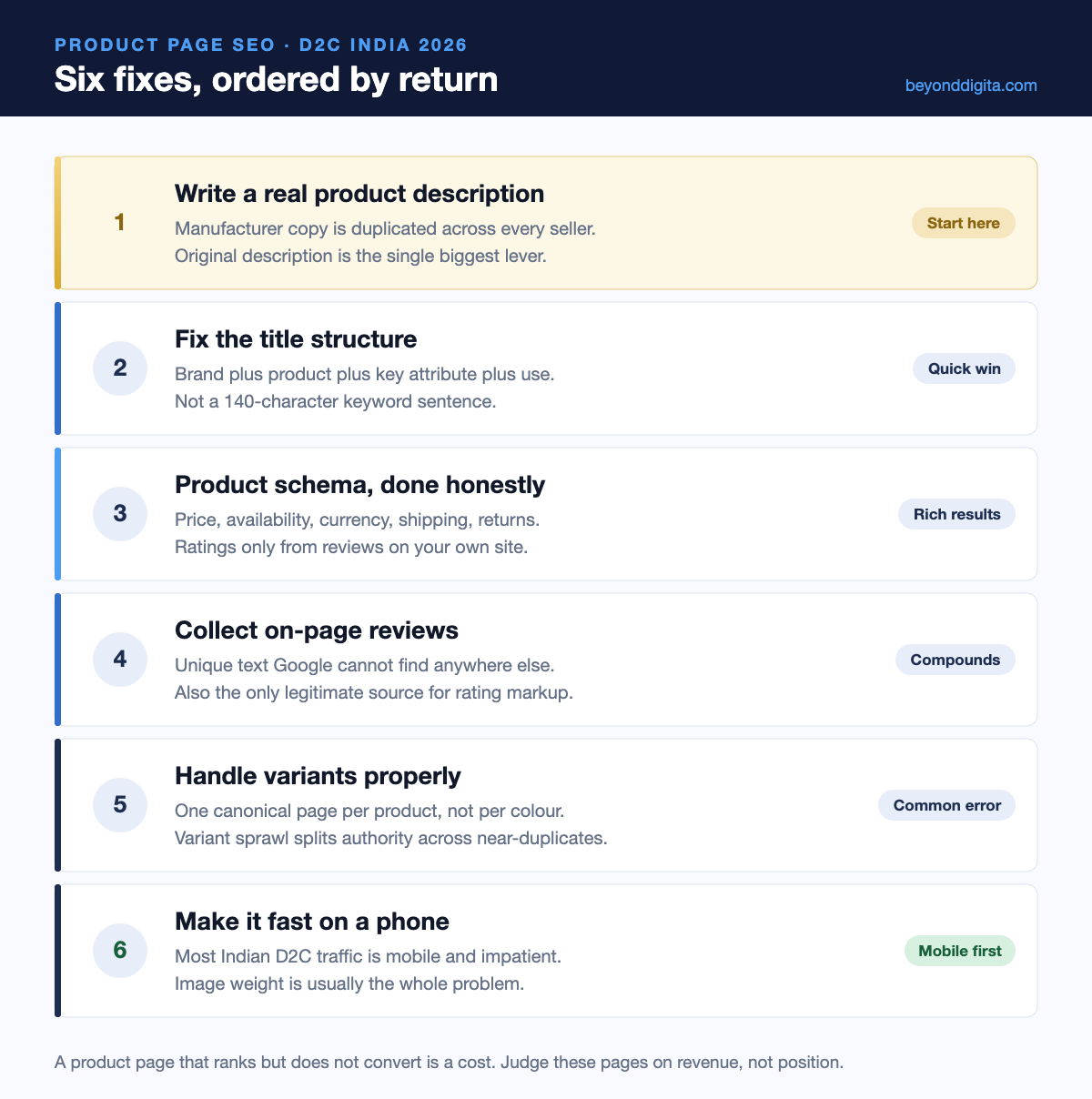
Original descriptions beat everything else
If you sell anything you did not manufacture, your description is probably identical to the one on twenty other sites. Google has no reason to prefer your page, and no amount of technical product page SEO compensates for text it has already seen elsewhere.
Write your own. Good product page SEO answers the questions customers actually ask before buying: how it fits, how long it lasts, what it works with, what it does not do. For Indian D2C specifically, address sizing honestly, mention whether care instructions suit local conditions, and be explicit about what is in the box.
This is slow work. A catalogue of four hundred products cannot be rewritten in a week. Start with the twenty that already receive impressions — your Search Console data tells you which — and treat product page SEO as a rolling programme rather than a project.
Title and heading structure
| Element | Good pattern | Common mistake |
|---|---|---|
| Title tag | Brand + Product + Key attribute | Keyword-stuffed 140 characters |
| H1 | The product name as a human says it | Repeating the full title tag |
| URL | /product-name/ — short and stable | /p/sku-48392-blue-xl/ |
| Meta description | Benefit, price signal, delivery promise | Auto-generated from the first line |
| Image alt | Describes the product and variant | IMG_4821.jpg or empty |
The URL row matters more than it looks. Short, readable, stable URLs protect your product page SEO through a replatform; SKU-based ones break every time you migrate, and every broken URL throws away whatever product page SEO value that page had earned.
Product schema, done honestly
Structured data on a product page can produce price, availability and rating directly in search results, which lifts click-through rate before any ranking change. It is one of the few parts of product page SEO with a visible, immediate payoff.
Include price, currency, availability, condition and the shipping and returns fields. Google’s product structured data documentation lists what is required and what is merely recommended, and the gap between the two is where most brands stop too early.
One firm rule: aggregateRating may only reflect reviews collected on your own site. Marking up ratings pulled from a marketplace, or inventing them, is a policy violation that can remove your rich results entirely. The same discipline applies as in LocalBusiness schema.
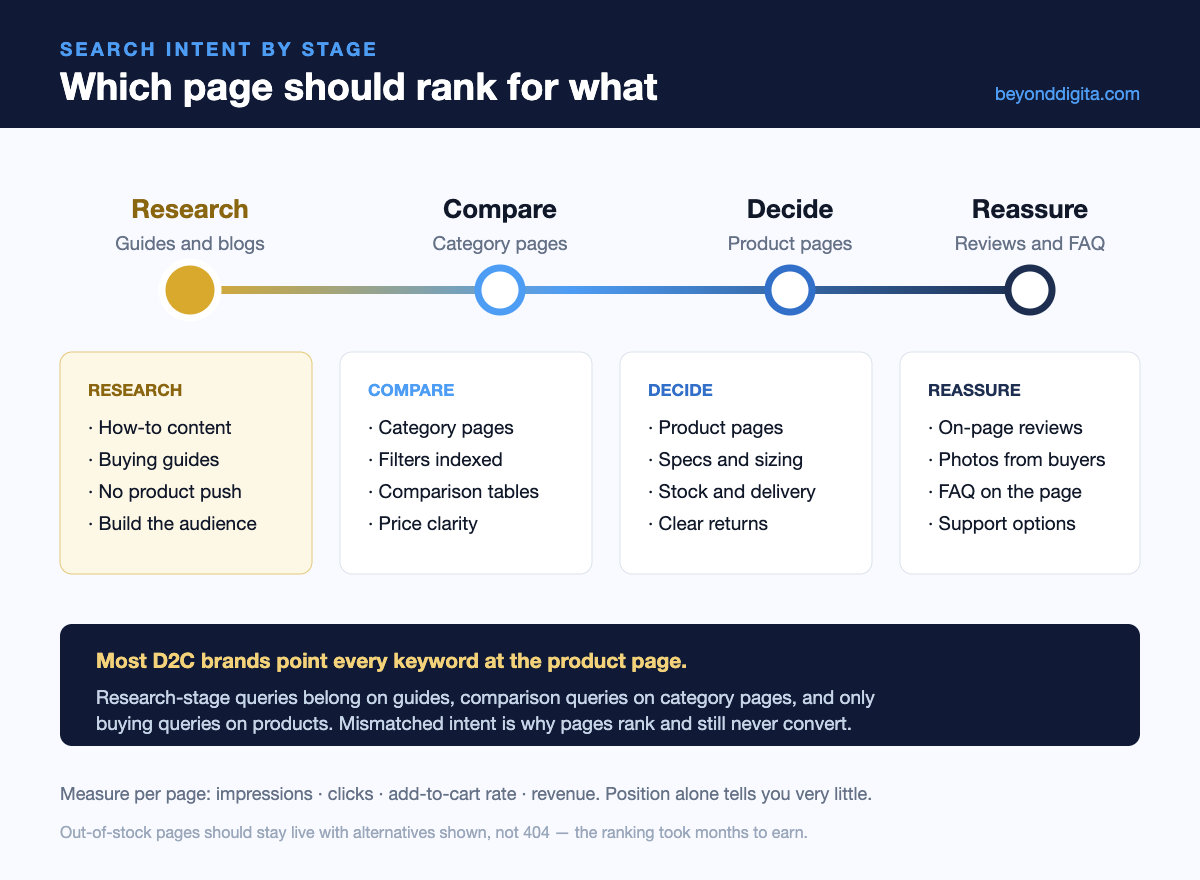
The intent mistake that wastes the most effort
Pointing every keyword at a product page is the most expensive error in D2C product page SEO, and almost everyone makes it.
Someone searching “how to choose running shoes” is not ready to buy. Send them to a product page and they bounce, which teaches Google the page is a poor answer. Someone searching “best running shoes under 5000” wants comparison — a category page with filters and a table. Only “buy [brand] [model] size 9” belongs on the product page itself.
Map your keywords to page types before optimising anything. The method is in our guide to keyword research, and getting it right means your product page SEO competes only on queries it can actually win.
Variants, stock and the pages you must not delete
- One canonical page per product. Not one per colour, or your product page SEO competes with itself. Variant sprawl splits authority across near-identical pages that compete with each other.
- Never 404 an out-of-stock product. Keep the page live, mark availability honestly, and show alternatives. The ranking took months to earn.
- Redirect discontinued products to the closest equivalent or the parent category — never to the homepage.
- Keep filtered URLs out of the index unless a filter combination has genuine search demand behind it.
- Do not prune product pages the way you would prune blog posts — the logic in our content pruning guide applies to content, not catalogue.
The out-of-stock rule is the one that costs brands most. Deleting a page during a stock gap discards every signal that page accumulated, and rebuilding it after restock takes months of product page SEO effort to recover.
Reviews on your own site
On-page reviews solve two product page SEO problems at once. They generate unique text that exists nowhere else, which is exactly what a duplicated catalogue lacks, and they are the only legitimate source for rating markup.
They also convert. A product page with twenty honest reviews outperforms an identical page without them regardless of position, which is why review collection belongs in any product page SEO plan rather than being treated as a separate marketing job. The request mechanics are the same ones we use for Google reviews.
Publish the negative ones too. A perfect five-star page reads as filtered, and Indian buyers in particular check the three-star reviews first.
Speed, because most of your traffic is mobile
Mobile speed is part of product page SEO whether you treat it that way or not. Indian D2C traffic skews heavily mobile, frequently on patchy connections. A product page carrying eight uncompressed images and four tracking scripts loses buyers before anything renders.
Image weight is almost always the whole problem. Serve modern formats, size them correctly, and lazy-load everything below the fold, following Google’s image best practices. Then check PageSpeed Insights on a real product page rather than the homepage, because product pages are the heaviest on most stores. Our guide to Core Web Vitals covers what to fix first.
What to measure on a product page
Position is the wrong headline metric here. A product page at position four that nobody adds to cart is worth less than one at position eleven that converts at six per cent.
| Metric | What it tells you | Act when |
|---|---|---|
| Impressions | Google understands the page exists | Flat after 8 weeks |
| Click-through rate | Title, price and rating are compelling | Below 1% at a decent position |
| Add-to-cart rate | The page itself persuades | Below 2% on buying queries |
| Revenue per session | The only number that pays salaries | Always worth watching |
| Mobile vs desktop gap | Speed or layout problem | Mobile converts half as well |
The click-through row is where product page SEO pays back fastest. A page already ranking that nobody clicks usually needs a better title and a visible price in the result, not more backlinks — and that is an afternoon of work rather than a quarter.
Track these per page rather than in aggregate, in GA4 alongside Search Console. Catalogue-wide averages hide the twenty pages doing all the work.
Where AI search changes things
Shopping queries increasingly return a summarised answer rather than ten blue links, and that changes what a product page has to do.
Assistants summarising options need machine-readable facts: price, availability, materials, dimensions, return policy. A page that buries specifications in an image cannot be summarised, so it gets left out. This makes structured data and plain-text specification tables a larger part of product page SEO than they were two years ago.
The practical response is unglamorous. Put specifications in real text, keep schema accurate and current, and make sure stock status reflects reality — a model that recommends an out-of-stock product once will deprioritise the source. We cover the broader shift in our guide to answer engine optimisation.
Frequently asked questions
How long is a good product description?
Long enough to answer the real questions — usually 150 to 400 words. Padding to hit a word count is obvious to readers and does nothing for product page SEO.
Should every product page have an FAQ?
Only where genuine questions exist, and then it genuinely helps product page SEO. Sizing, care, compatibility and delivery are worth answering. Invented questions add length without value.
Do I need blog content as well?
Yes, but for research-stage queries that product pages should not chase. The two work together — content builds the audience, product page SEO converts it.
What about marketplace listings?
Marketplaces often outrank your own product page SEO for your own products. That is not a reason to stop — owned-site customers are worth more and are yours to retain, as our work on first-party data sets out.
Start with twenty pages, not four hundred
The brands that get results do not rewrite the whole catalogue. They apply product page SEO to the twenty products already receiving impressions, fix those properly, measure what changed, then move to the next twenty.
If you want to know which of your pages are closest to earning real traffic, send us access to Search Console. Our SEO team will tell you where the product page SEO returns are, and whether paid would get you there faster.