

Nearly every Indian business has been sold a package of five hundred directory submissions at some point. Bulk business directories submission is one of the most persistent bad products in this industry, and it actively damages the thing it claims to improve. Most business directories are worthless; a small number genuinely matter.
This guide ranks which Indian business directories are worth your time, explains why consistency matters more than volume, and gives a clean-up process you can run yourself in an afternoon. It is the citation half of the work covered in our Delhi NCR local SEO guide.
What a citation actually does
A citation on one of these business directories is any mention of your business name, address and phone number online, whether or not it links to you. Google uses them to corroborate that your business is real and that its details are what you claim.
That word — corroborate — is the whole point. Listings on business directories are evidence, not endorsements. Twenty listings all saying the same thing build confidence. Five hundred listings saying six slightly different things destroy it.
This is why bulk submission packages are worse than doing nothing. They generate volume at the cost of accuracy, and inconsistent entries are the single most common reason a local listing underperforms with no obvious cause.
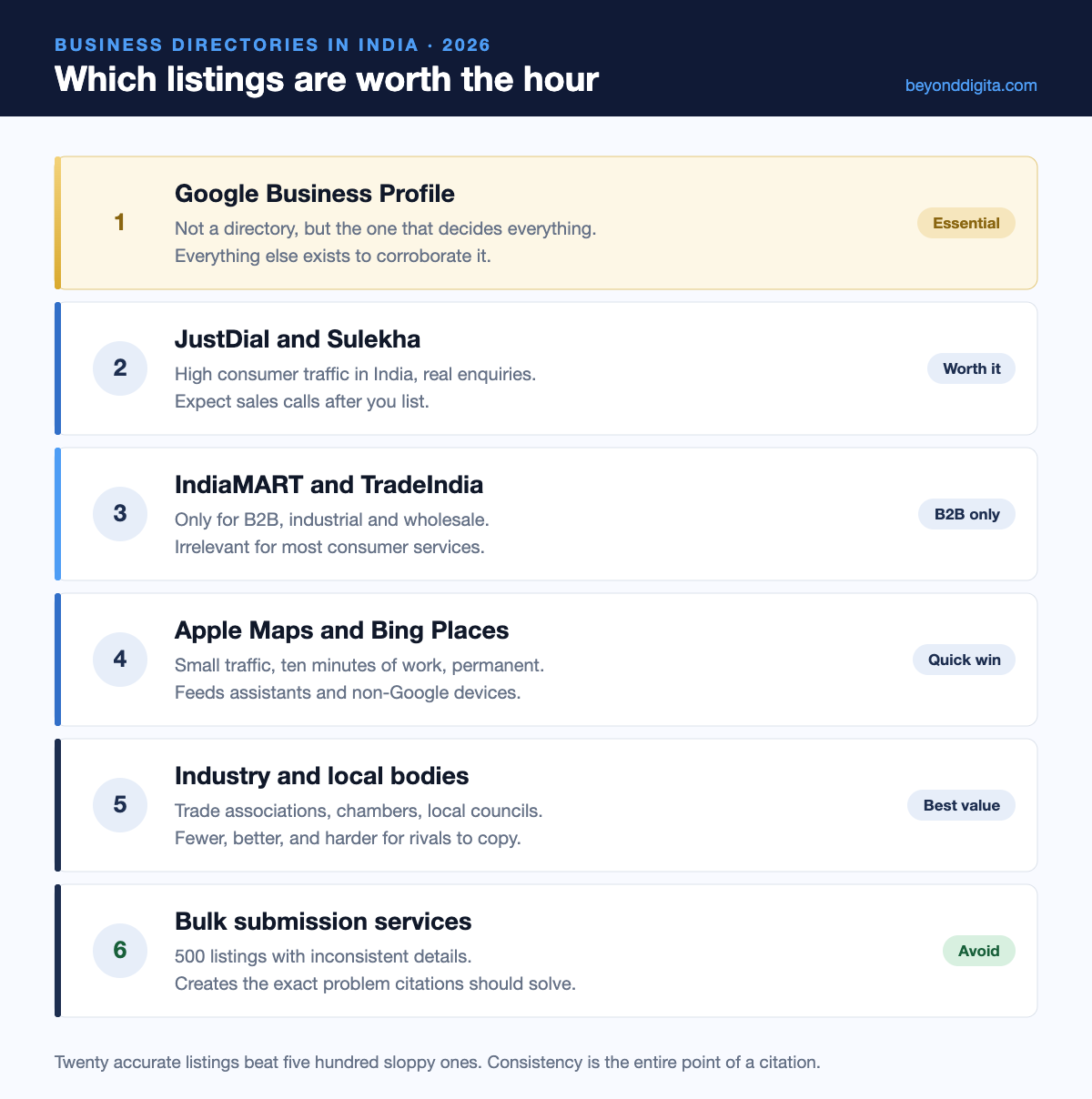
Which Indian directories are worth it
| Listing | Worth it for | Priority |
|---|---|---|
| Google Business Profile | Every local business, without exception | Critical |
| JustDial | Consumer services, real enquiry volume | High |
| Sulekha | Home services, trades, tutors | High |
| Bing Places | Ten minutes, permanent, feeds assistants | Medium |
| Apple Maps Business Connect | iPhone users, navigation | Medium |
| IndiaMART and TradeIndia | B2B, industrial, wholesale only | High for B2B |
| Trade bodies and chambers | Credibility and genuine referrals | High |
| Practo, Zomato, UrbanClap | Only if you are in that vertical | Vertical-specific |
| Generic link directories | Nothing. Actively harmful in bulk | Avoid |
The vertical-specific row deserves emphasis. A clinic listed on Practo gains far more than the same clinic on forty general sites, because the vertical platform carries both authority and actual patients.
One honest warning about Indian directories: listing your number on JustDial or IndiaMART will generate sales calls, often for months. Use a business number you are content to have published widely, not a personal mobile.
Decide your NAP format first
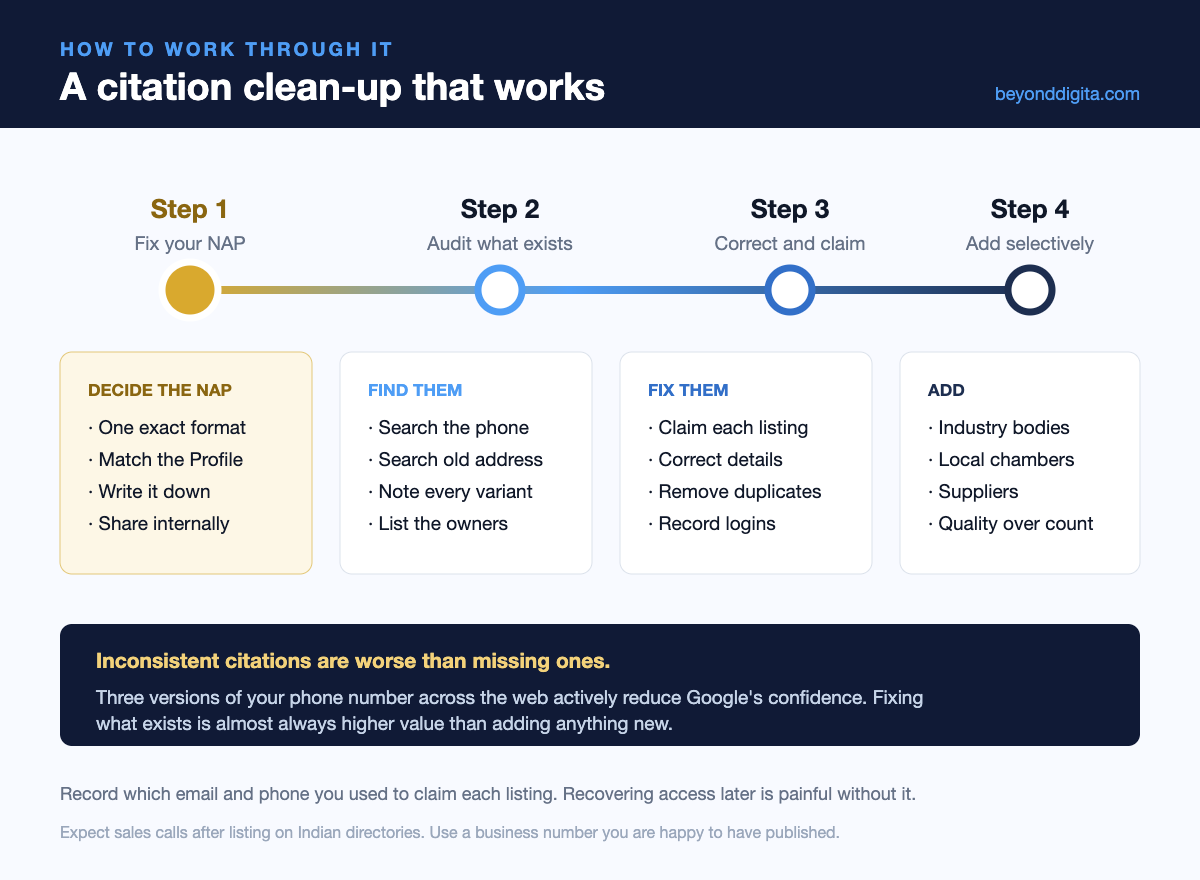
Before touching any of your business directories listings, write down exactly one version of your name, address and phone number — then use it everywhere without variation.
It must match your Google Business Profile precisely. “Rd” and “Road” are different strings. “Pvt Ltd” and “Private Limited” are different strings. A landline with and without the STD code are different strings. Every variation across business directories is a small reduction in Google’s certainty that these entries describe one business.
Write it in a shared document so staff creating future listings use the same format. This is boring and it is the single highest-return step in the whole exercise.
Audit what already exists
Most businesses appear on more business directories than they realise. Previous agencies created them, aggregators scraped them, and old addresses persist for years, exactly as Google warns in its representation guidelines.
- Search your phone number in quotation marks. The fastest way to surface listings you never made.
- Search your old address if you have moved. Stale entries are the most damaging kind.
- Search business name plus city and go three pages deep, then check review platforms too.
- Record every variant you find in a sheet, with the Profile details you are matching against.
- Note who controls each one and whether you can claim it.
Correcting what you find beats adding anything new. If a business has twelve inconsistent business directories entries, fixing those is worth more than creating thirty accurate ones alongside them.
The listings that beat generic directories
There is a category of citation that most agencies never mention, because it cannot be bought in bulk and takes real effort. It also works better than any package of business directories.
Trade associations and professional bodies list members with full contact details. Local chambers of commerce do the same. Suppliers and manufacturers often maintain dealer or partner pages. Schools, hospitals and housing societies list approved vendors. Sponsorship of a local event usually earns a page with your name and address on it.
Each of these is harder for a competitor to replicate than a directory submission, carries more credibility, and often sends actual referrals rather than only corroboration. Five of these outperform fifty generic business directories entries, and they tend to persist for years.
They also feed the unstructured mentions that AI systems increasingly read when deciding which businesses to name in an answer — something we cover in our work on answer engine optimisation.
A realistic clean-up timetable
| Stage | Time | What you do |
|---|---|---|
| Decide the NAP | 15 minutes | One exact format, written down and shared |
| Audit existing | 60–90 minutes | Phone search, old address, name plus city |
| Claim and correct | 2–4 hours | Fix the ones you control, log every login |
| Add the core set | 2 hours | Fifteen relevant listings, same details |
| Annual recheck | 30 minutes | Confirm nothing drifted or reappeared |
Under a working day to put every one of your business directories right, then half an hour a year. Any proposal that turns business directories into a recurring monthly line item is charging you for a job that finishes.
Record which email address and phone number you used to claim each listing. Recovering access two years later, after the staff member who created it has left, is the most tedious part of this entire exercise — and it happens constantly.
What to do about ones you cannot fix
Some business directories resist correction. The site is abandoned, the claim process is broken, or nobody answers support requests.
For low-traffic aggregator sites, accept it and move on — one stale entry among twenty correct ones carries little weight. Spend the effort where volume is: the handful that actually send traffic in India matter far more than the long tail nobody visits.
The exception is an old address on a prominent platform, which is worth genuine persistence. Those feed other systems and can keep resurfacing, including in structured data that assistants read.
Why bulk submission packages keep selling
If five hundred submissions are harmful, why does anyone still sell them? Because they are cheap to deliver, easy to evidence, and impossible for a client to evaluate.
A spreadsheet of five hundred URLs looks like a great deal more work than fixing twelve existing entries. It arrives on the first of the month, it is countable, and it requires no judgement. Correcting a wrong phone number on an old listing takes an hour of chasing support and produces nothing to put in a report.
That incentive gap explains most of what is wrong with how business directories are sold in India. The work that helps is slow, dull and unglamorous; the work that sells is fast, bulky and visible.
If an agency proposes citation volume as a monthly deliverable, ask how many existing listings carry incorrect details today. A firm that cannot answer has not looked, and the same test applies when choosing any agency.
Citations are not the whole answer
Worth being straight about this, because citation work is easy to sell and easy to overstate.
Listings on business directories are foundational rather than decisive. They remove a reason not to rank; they rarely create a reason to rank. A business with perfect business directories coverage and nine reviews will still lose to a rival with messy citations and four hundred reviews, because review volume carries more weight.
So treat business directories as a one-off clean-up plus an annual check, not an ongoing programme. Google names relevance, distance and prominence as its local ranking factors, and citations are a modest contributor to the third.
Frequently asked questions
How many business directories do I need?
Fifteen to twenty accurate, relevant business directories covers almost every Indian local business. Beyond that the returns are negligible and the risk of inconsistency rises.
Do citations need to link to my site?
No. An unlinked mention with correct details still corroborates your business. The link is a bonus rather than the purpose.
Are paid listings worth it?
Sometimes, but judge paid business directories as advertising rather than SEO. JustDial’s paid placement can produce genuine enquiries; buying a paid listing purely for ranking benefit is not worth it.
What about a service area business?
Harder, since many business directories demand a public address. Use one consistent format across all local listings where it is unavoidable, as covered in our service area business guide.
An afternoon, once a year
Fix your NAP format, audit what exists, correct what you can, add the fifteen that matter for your category. That is the entire job, and nobody needs to be paid monthly to repeat it.
If you would rather we ran the audit, send us your business name and number. Our local SEO team will tell you which business directories currently carry wrong details — and whether citations are actually your bottleneck or just the easiest thing to sell you.