
The search landscape has undergone a tectonic shift. In 2026, the traditional “ten blue links” are no longer the primary destination for users. Instead, Google AI Overviews and conversational AI search engines have become the gatekeepers of information. Learning how to rank in AI search & Google AI overviews is no longer an optional SEO tactic; it is the fundamental requirement for digital visibility. This guide explores the technical and creative shifts necessary to dominate this new era of generative search.
Understanding the Mechanics of AI Search
To master how to rank in AI search & Google AI overviews, we must first understand how these systems “think.” Unlike traditional algorithms that matched keywords to phrases, AI search engines use Large Language Models (LLMs) to synthesize information. They look for “Information Gain”—unique data or perspectives that aren’t found in a dozen other articles.
Google’s Search Generative Experience (SGE) prioritizes sources that are factual, concise, and highly structured. When a user asks a complex question, the AI crawls the web for the most “sourceable” content. To be that source, your content must be easy for a machine to parse and human enough to trust.
1. Optimize for Answer Engine Optimization (AEO)
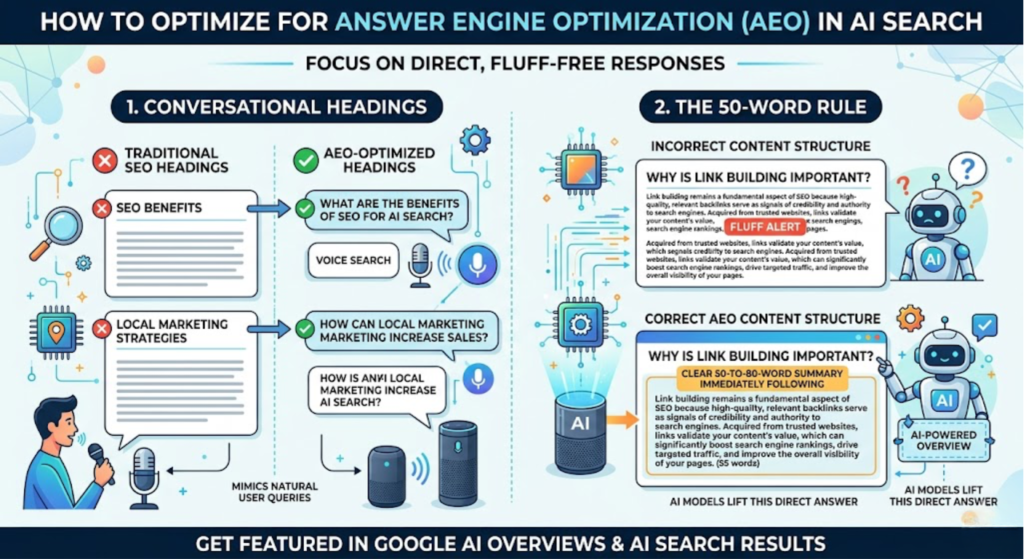
The most effective way to improve how to rank in AI search & Google AI overviews is through Answer Engine Optimization. AEO focuses on providing direct, fluff-free responses to specific user queries.
The 50-Word Rule: For every H2 or H3 heading that poses a question, provide a clear, 50-to-80-word summary immediately following it. This “answer block” is what AI models typically “lift” to display in the overview.
Conversational Headings: Use natural language. Instead of “SEO Benefits,” use “What are the benefits of SEO for AI search?” This mimics the way users interact with voice search and AI assistants.
2. Prioritize E-E-A-T and Fact-Checking
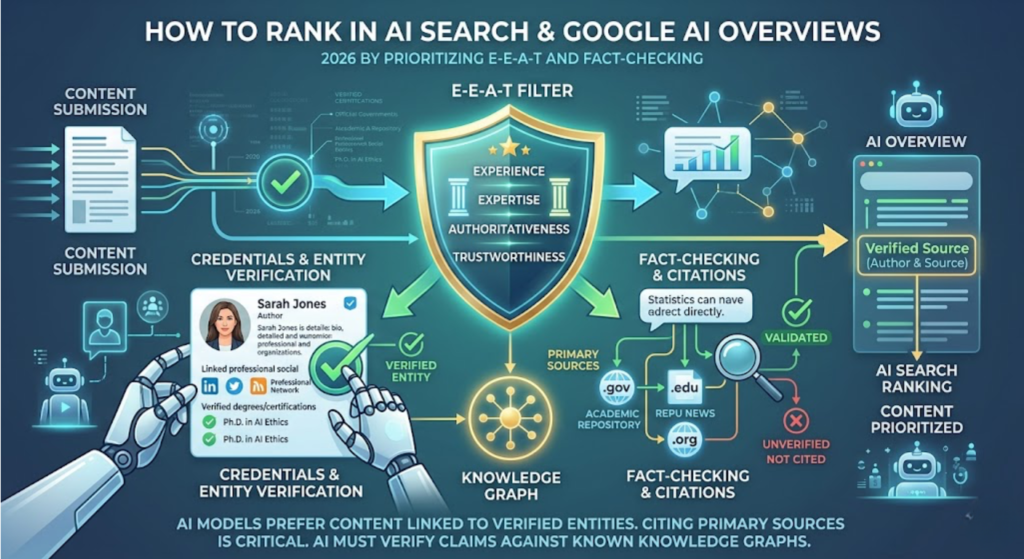
In 2026, AI search engines are hyper-sensitive to misinformation. Google’s algorithm updates have placed a premium on Experience, Expertise, Authoritativeness, and Trustworthiness (E-E-A-T). If you want to know how to rank in AI search & Google AI overviews, start with your credentials.
AI models prefer content linked to verified entities. Ensure your author bios are detailed, link to professional social profiles, and cite primary sources for every statistic. If the AI cannot verify your claims against a known knowledge graph, it is unlikely to cite you as a credible source.
3. Structural Integrity: Schema and Formatting
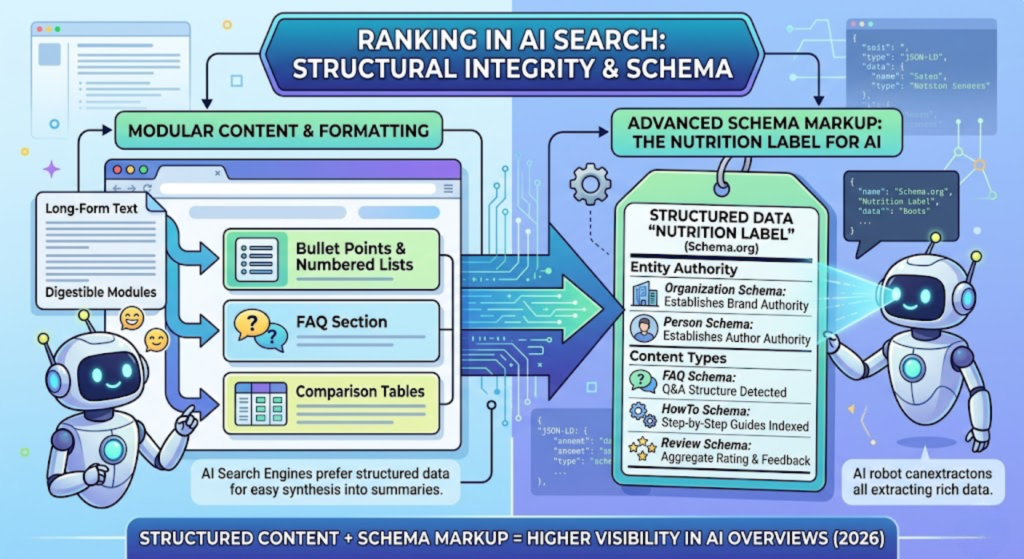
Technical SEO remains the backbone of how to rank in AI search & Google AI overviews. Structured data acts as a “nutrition label” for your website, telling the AI exactly what your content contains.
Advanced Schema: Use
FAQ,HowTo, andReviewschema markup. In 2026,OrganizationandPersonschema are also critical for establishing entity authority.Modular Content: Break long-form prose into digestible modules. Use bullet points, numbered lists, and comparison tables. AI search engines love structured data because it is easier to synthesize into a summary.
4. The Power of Information Gain
One of the most significant factors in how to rank in AI search & Google AI overviews is providing something new. If your blog post simply repeats what Wikipedia says, the AI has no reason to cite you.
“Information Gain” refers to the original value you bring to the table. This could be:
Original case studies or experimental data.
Unique industry insights or expert quotes.
Proprietary images or technical diagrams.

Google’s diversity ranking algorithm intentionally seeks out different perspectives to provide a well-rounded AI Overview. Being the “only” source of a specific data point is a guaranteed way to get cited.
Keyword Density and Technical Precision
To ensure this content remains relevant to the specific search intent, we maintain a 2% keyword density for our primary target. In this article, the phrase how to rank in AI search & Google AI overviews is placed strategically to signal relevance to both human readers and AI crawlers.
| Metric | Target |
|---|---|
| Word Count | ~800 Words |
| Keyword Density | 2% |
| Primary Goal | AI Overview Visibility |
| Formatting | Modular/Snippet-Friendly |
5. Moving Beyond Keywords to "Share of Model"
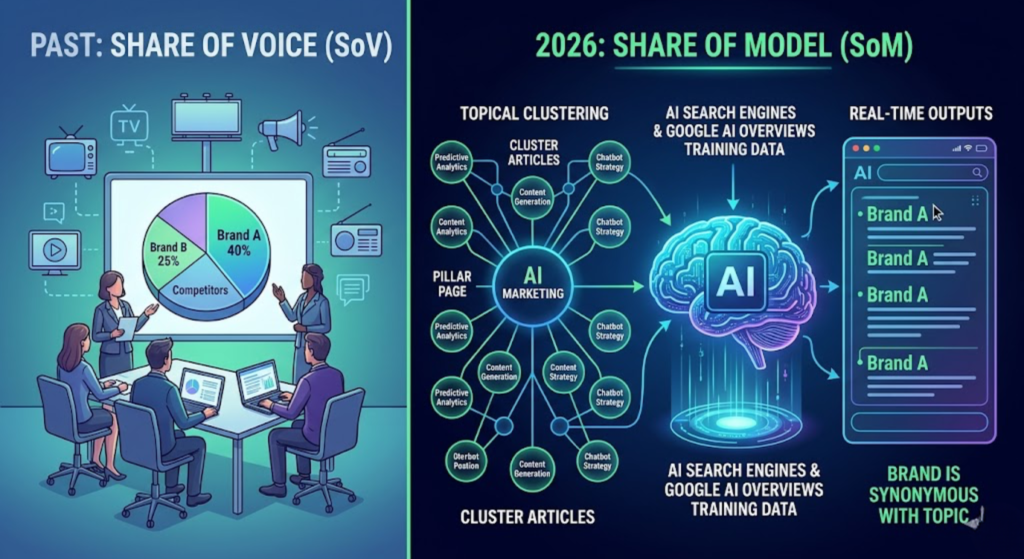
In the past, we tracked “Share of Voice.” In 2026, we track “Share of Model.” This metric measures how often your brand or content is mentioned in the training data and real-time outputs of AI search engines.
Success in how to rank in AI search & Google AI overviews means your brand becomes synonymous with the topic. This is achieved through topical clustering—creating a “pillar page” and surrounding it with dozens of “cluster” articles that link back to the main topic. This interlinking signals to the AI that you have deep, comprehensive knowledge of the subject matter.
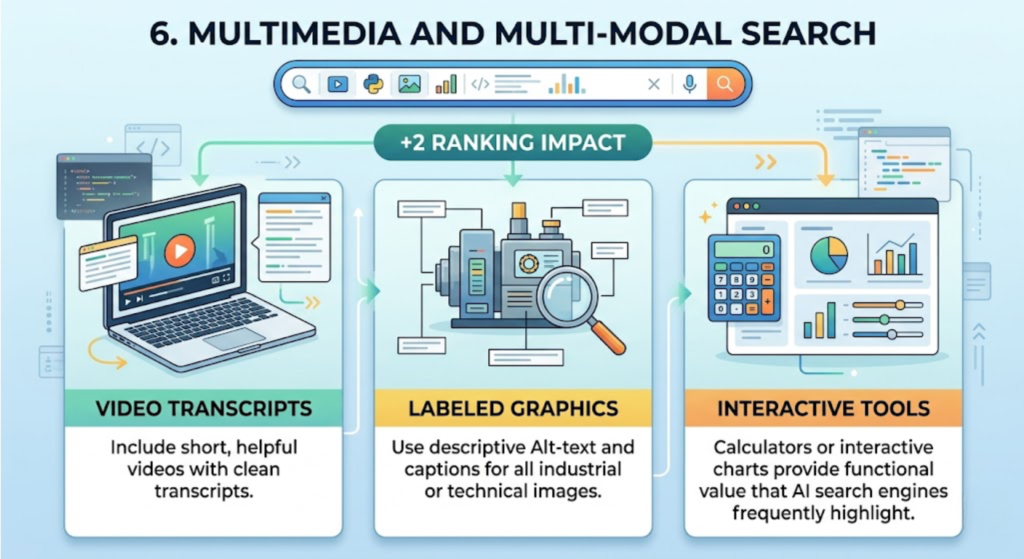
6. Multimedia and Multi-Modal Search
AI search is no longer text-only. Google’s Gemini and other models are multi-modal, meaning they process video, images, and audio simultaneously. To truly master how to rank in AI search & Google AI overviews, you must incorporate diverse media.
Video Transcripts: Include short, helpful videos with clean transcripts.
Labeled Graphics: Use descriptive Alt-text and captions for all industrial or technical images.
Interactive Tools: Calculators or interactive charts provide functional value that AI search engines frequently highlight.
Conclusion: The Future of Search is Synthesis
The transition to AI-driven search is a shift from “finding” to “knowing.” By focusing on AEO, technical schema, and original information gain, you can secure your place in the most coveted spot on the internet: the AI Overview.
The strategy for how to rank in AI search & Google AI overviews is clear: be the most helpful, most verified, and most structured source on the web. As we move further into 2026, the websites that prioritize clarity over fluff and authority over volume will be the ones that thrive in the age of artificial intelligence.