
The digital landscape is undergoing a monumental shift. As we navigate through 2026, online marketing is no longer just about being visible; it is about being relevant, trustworthy, and technologically integrated. From the rise of Generative Engine Optimization (GEO) to the decline of third-party cookies, the strategies that worked five years ago are rapidly becoming obsolete.
In this guide, we will explore the essential pillars of online marketing success in the current era and how you can optimize your brand for a future defined by AI and community.
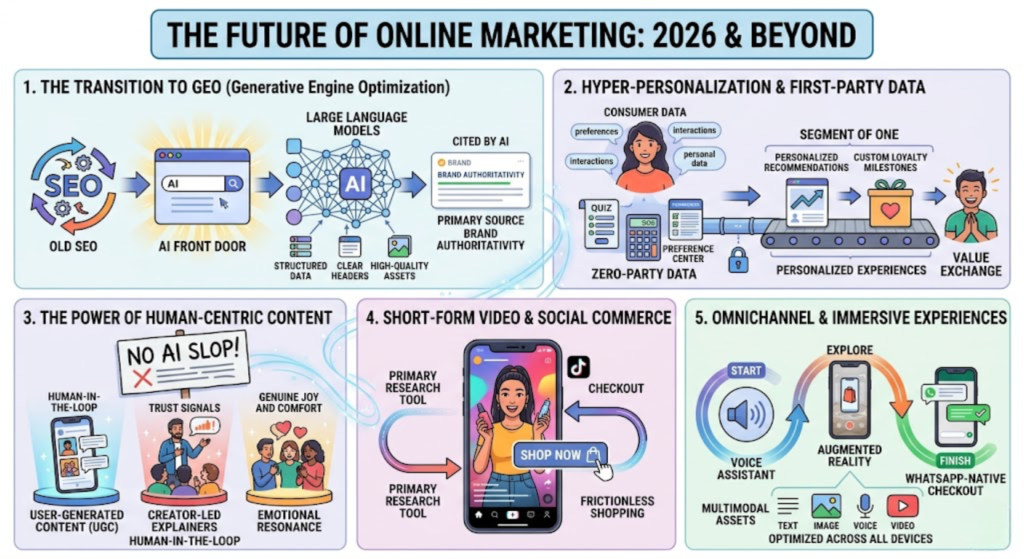
1. The Transition to Generative Engine Optimization (GEO)
For decades, SEO was the backbone of online marketing. However, with the integration of AI “front doors” on search queries, the way users find information has changed. We have entered the era of GEO.
In modern online marketing, your content must be machine-legible and authoritative enough for Large Language Models (LLMs) to cite you as a primary source. This requires structured data, clear headers, and high-quality assets that AI agents can easily parse and recommend to users. If the models don’t know your brand, your online marketing efforts will effectively be optimized out of the conversation.
2. Hyper-Personalization: The New Standard
Consumers in 2026 expect a “segment of one” experience. Successful online marketing now relies on first-party data strategies to deliver hyper-personalized content. With privacy regulations tightening, brands are moving away from intrusive tracking and toward a transparent value exchange.
By using zero-party data—information consumers proactively share through quizzes, calculators, and preference centers—your online marketing can provide immediate rewards and joy. Whether it’s a personalized product recommendation or a custom loyalty milestone, personalization is the cornerstone of modern customer retention.
3. The Power of Human-Centric Content
While AI handles the heavy lifting of data analysis, the “human-in-the-loop” is what makes online marketing authentic.We are seeing a massive pushback against “AI slop”—generic, uninspired content that clutters feeds.
To stand out, your online marketing must lean into:
User-Generated Content (UGC): Real people sharing real experiences remains the ultimate trust signal.
Creator-Led Explainers: Niche creators with loyal communities often outperform polished, high-budget advertisements.
Emotional Resonance: In an uncertain world, brands that offer comfort, simplicity, and emotional reassurance win the most loyalty.
4. Short-Form Video and Social Commerce
Video continues to dominate the online marketing space. However, it has evolved from pure entertainment into a vital research tool. Short-form clips on platforms like TikTok and Instagram are now the primary way younger generations explore products.
Integrating frictionless shopping experiences directly into these videos is essential. A robust online marketing strategy ensures that the “discovery-to-checkout” loop is as short as possible, allowing users to purchase without ever leaving their favorite social environments.
Strategic Online Marketing Framework
| Focus Area | Online Marketing Tactic | Strategic Goal |
|---|---|---|
| Search | Generative Engine Optimization | AI-driven brand citations |
| Data | First-Party & Zero-Party Data | Privacy-compliant personalization |
| Media | Short-Form & Shoppable Video | Higher conversion and ROI |
| Trust | UGC & Human Oversight | Brand authenticity and safety |
5. Omnichannel and Immersive Experiences
Online marketing in 2026 is truly omnichannel. A user might start a search via a voice assistant, explore a product using Augmented Reality (AR) on their phone, and finish the purchase through a WhatsApp-native checkout flow.
Providing a seamless experience across these touchpoints is no longer a luxury. Your online marketing assets must be multimodal—optimized for text, image, voice, and video—to meet the consumer wherever they are.
Conclusion: The Future of Your Online Marketing
The brands that will thrive in 2026 are those that balance machine-driven efficiency with human-driven empathy. Online marketing is no longer a game of volume; it is a game of value. By focusing on GEO, prioritizing first-party data, and maintaining a commitment to authenticity, your business can navigate the complexities of the digital age with confidence.
As you plan your next campaign, remember that effective is about being the most helpful answer in a sea of automated noise. Start auditing your strategy today to ensure you are ready for the challenges and opportunities of the year ahead.