
The landscape of digital marketing has shifted. As we navigate 2026, the era of typing fragmented keywords into a search bar is fading. In its place, we find a world of dialogue. Users are no longer just searching; they are talking—to their phones, their cars, and their homes. This evolution has made conversational search optimization the most critical pillar of any modern SEO strategy.
If your content still reads like a robotic list of keywords, you are missing out on the primary way information is consumed today. To stay visible, you must understand how to align your brand with the natural flow of human speech.
What is Conversational Search Optimization?
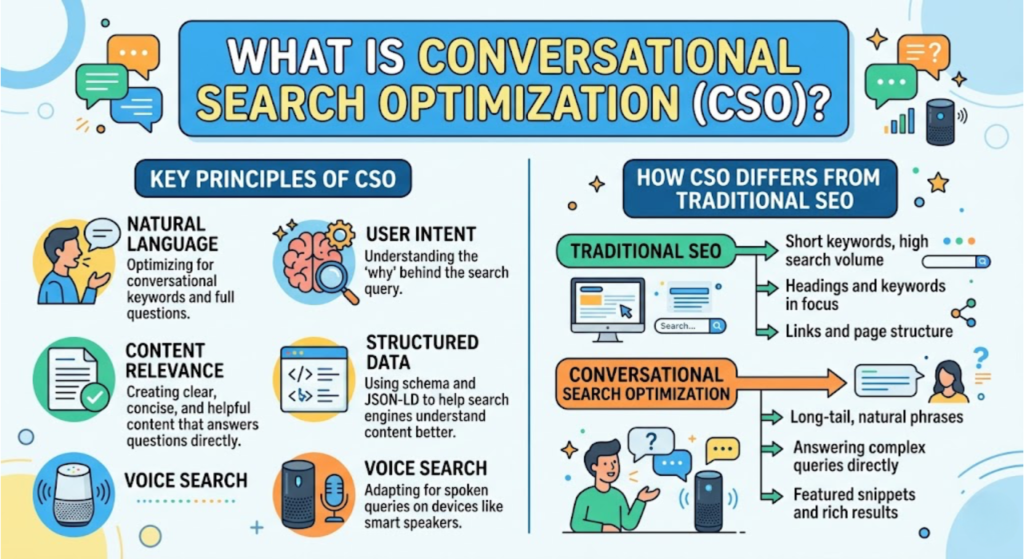
At its core, conversational search optimization is the process of structuring your digital presence to answer natural language queries. Unlike traditional SEO, which often focused on short-tail keywords (e.g., “best pizza NYC”), this approach targets the way people actually speak (e.g., “Where is the best gluten-free pizza place open now near me?).
In 2026, AI-driven search engines like Google and specialized LLM assistants have become highly sophisticated. They don’t just look for word matches; they look for intent, context, and authority. Conversational search optimizationensures that when an AI “reads” your site, it finds clear, concise, and structured answers that it can easily relay back to a user
Why It Matters More Than Ever
The rise of “zero-click” searches means that AI assistants often provide the answer directly on the search results page. To be the source that the AI cites, your conversational search optimization must be flawless.
Higher Intent: Users asking conversational questions are often further along in the buyer’s journey.
Voice Search Dominance: With more than 50% of searches now occurring via voice, conversational search optimization is the only way to capture that mobile-first audience.
Trust and Authority: AI models prioritize content that sounds human and provides direct value.
Core Strategies for Conversational Search Optimization
To dominate the rankings this year, you need to move beyond old-school tactics. Here are the four pillars of successful conversational search optimization:
1. Target Long-Tail, Natural Language Phrases
Stop optimizing for “running shoes” and start optimizing for “what are the most durable running shoes for trail marathons?” Conversational search optimization thrives on specificity. Use tools to find the exact questions your customers are asking and weave those phrases naturally into your headers
2. Implement "Answer Snippets"
AI assistants love “snackable” information. When performing conversational search optimization, structure your paragraphs to lead with a direct answer. Aim for a 40–60 word “definition” or “answer block” at the start of your sections.This makes it incredibly easy for an AI to pull your text as a featured snippet.
3. Use Question-Based Headings
Your H2s and H3s should mirror the queries of your audience. Instead of a heading that says “Product Features,” use “How does [Product Name] improve workflow efficiency?” This direct alignment is a hallmark of effective conversational search optimization.
4. Prioritize Schema Markup and Technical Clarity
Behind the scenes, conversational search optimization requires technical precision. Use FAQ and How-To schema markup to tell search engines exactly what questions you are answering. The clearer your site’s structure, the more likely you are to be the “chosen” answer in a voice dialogue.
The Shift from Keywords to Context
The most common mistake in conversational search optimization is keyword stuffing. In 2026, AI can detect “over-optimized” content from a mile away. True conversational search optimization feels like a helpful conversation between two experts.
Focus on the “why” and “how” rather than just the “what.” By providing depth and context, you signal to search engines that your site is a topical authority. Remember, conversational search optimization isn’t just about getting a click; it’s about being the most trusted voice in the room.
Measuring Success in 2026
Traditional metrics like “page views” are changing. In a world dominated by conversational search optimization, you should track:
AI Mentions: How often is your brand cited in AI-generated overviews?
Featured Snippet Ownership: Are your answer blocks appearing at the top of the SERP?
Conversion Quality: Are the users coming from long-tail queries more likely to buy?
Focus on the “why” and “how” rather than just the “what.” By providing depth and context, you signal to search engines that your site is a topical authority. Remember, conversational search optimization isn’t just about getting a click; it’s about being the most trusted voice in the room.
Conclusion
The “search bar” is becoming a “chat box.” Brands that ignore conversational search optimization will find themselves invisible in an era of AI assistants and voice-driven commerce. By focusing on natural language, user intent, and clear structure, you can ensure that your business remains the go-to answer for every question your customers ask.
Start your journey into conversational search optimization today—because in 2026, if you aren’t part of the conversation, you aren’t part of the search.