In the modern landscape of social media marketing, data is the fuel that powers every high-performing campaign. However, as privacy regulations tighten and third-party cookies crumble, the “where” and “how” of data collection have become critical.
If you want to stay ahead in social media marketing, you must understand the distinction between Zero-Party Data and First-Party Data. While they both come directly from the consumer, they serve different roles in your funnel.
What is First-Party Data? (The Behavioral Insight)
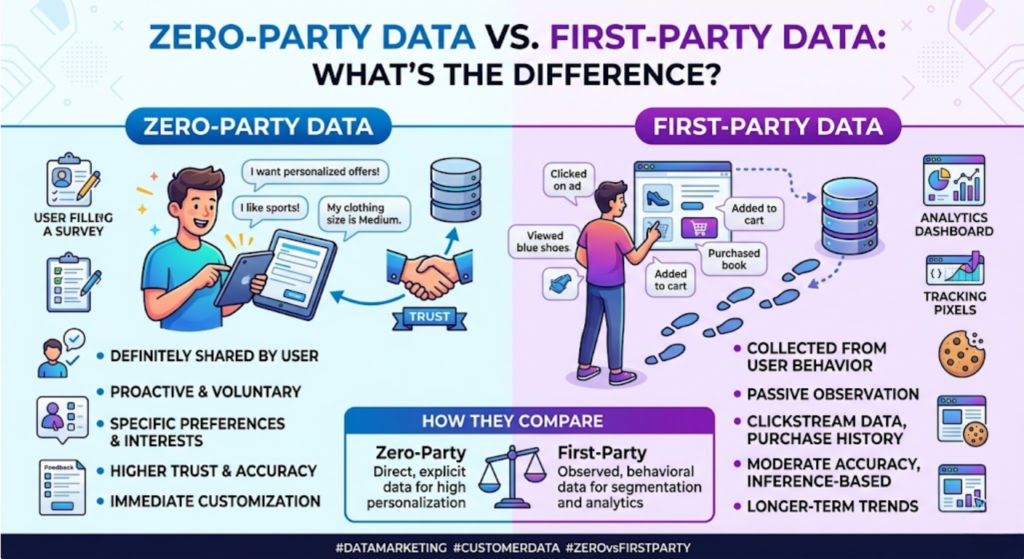
First-party data is information your brand collects directly from your audience’s actions and behaviors on your owned channels. It is “observed” data. When a user interacts with your website, clicks an ad, or engages with a post, they leave a digital trail.
Key Examples in Social Media Marketing:
Engagement Metrics: Which posts did they “Like” or “Share”?
Pixel Tracking: What products did they view on your site after clicking a link in your Instagram bio?
Purchase History: What have they bought from you in the past?
App Usage: How often do they open your mobile app?
In the context of social media marketing, first-party data is gold for retargeting. If a user watches 75% of your video on Facebook, you know they are interested, even if they didn’t say a word.
What is Zero-Party Data? (The Direct Conversation)
Zero-party data—a term coined by Forrester Research—is information that a customer intentionally and proactivelyshares with you. Unlike first-party data, which is gathered through observation, zero-party data is gathered through conversation.
Key Examples in Social Media Marketing:
Instagram Polls: “Do you prefer Matte or Glossy finish?”
Quizzes: “Take our 2-minute survey to find your perfect skincare routine.”
Preference Centers: A user telling you they only want to receive emails about “Men’s Running Shoes.”
Lead Forms: A LinkedIn lead gen form where a user specifies their job role and budget.
For social media marketing professionals, zero-party data is the ultimate shortcut to personalization because the customer is literally telling you exactly what they want.
Zero-Party vs. First-Party Data: Key Differences
While both are “direct-from-source,” the nuances are vital for any social media marketing strategy.
| Feature | First-Party Data | Zero-Party Data |
|---|---|---|
| Source | Observed behavior/actions | Explicitly shared by user |
| Collection Method | Passive (Pixels, Cookies, CRM) | Active (Quizzes, Polls, Surveys) |
| Accuracy | High (but requires interpretation) | Highest (straight from the source) |
| Intent | Inferred (They looked at X, so they might want Y) | Declared (They said “I want Y”) |
| Privacy Risk | Low (if consented) | Lowest (purely voluntary) |
Why Both Matter for Social Media Marketing in 2026
In 2026, the most successful social media marketing strategies use a hybrid approach.
1. Eliminating the "Creepy" Factor
We’ve all had that experience where we look at a pair of shoes once and they haunt us across every social platform for a month. That’s first-party data retargeting. However, when you use zero-party data—like a quiz where the user said they are looking for “hiking boots”—and then show them hiking boots, the ad feels helpful rather than intrusive.
2. Hyper-Personalization at Scale
By combining these data sets, social media marketing teams can create segments that are incredibly specific.
Example: You can target users who viewed your summer collection (First-Party) AND voted in a Twitter poll that they prefer the color “Ocean Blue” (Zero-Party).
3. Building Long-Term Trust
As privacy becomes a top priority for consumers, asking for permission is the new currency. In social media marketing, transparently asking for preferences through interactive content builds a relationship. Users are happy to give you data if they know it results in a better, more tailored experience.
How to Collect Better Data via Social Media
To maximize your social media marketing ROI, start integrating these collection methods:
Interactive Stories: Use the “Poll” or “Slider” features on Instagram and TikTok to gauge product interest.
Conversational AI: Use chatbots on Facebook Messenger or WhatsApp to ask users about their preferences during the discovery phase.
Gated Value: Offer a “Buying Guide” or “Style Report” in exchange for a short survey. This is a staple of high-conversion social media marketing.
Final Thoughts
The shift from third-party cookies to direct data is the best thing that ever happened to social media marketing. It forces brands to actually talk to their customers.
First-party data tells you what they did. Zero-party data tells you why they did it. When you master both, your social media marketing doesn’t just reach people—it resonates with them.