
The digital advertising landscape is currently undergoing its most significant transformation since the invention of the pop-up ad. For years, we’ve heard whispers of the “cookie apocalypse,” and as we navigate 2026, the extinction of third-party cookies is no longer a distant threat—it is a functional reality. While the journey here was filled with delays and pivots, the shift toward a privacy-first internet has fundamentally changed how we track, target, and convert customers.
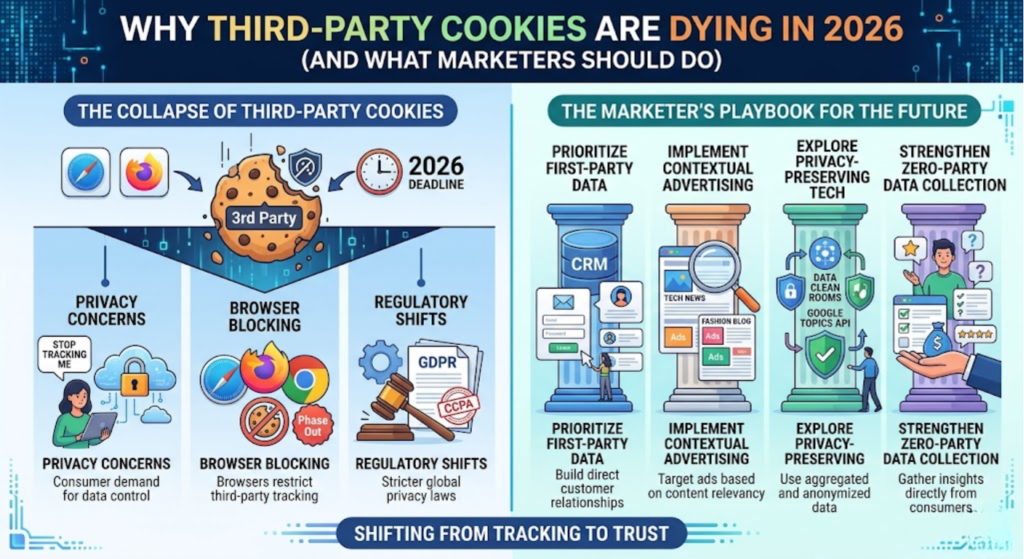
The Great Collapse of Third-Party Cookies
To understand why third-party cookies are dying in 2026, we have to look at the “Global Consent Prompt.” In 2025, Google shifted away from a total technical ban in Chrome, opting instead to give users a clear, one-time choice to opt-in or out of tracking.
The results have been definitive: much like Apple’s App Tracking Transparency (ATT) rollout, the vast majority of users are choosing privacy. When given a simple “No” button, users are taking it. This “informed choice” model has effectively drained the pool of available data, making third-party cookies an unreliable foundation for any modern marketing department.
Furthermore, international regulations like the GDPR, CCPA, and the newly enforced EU AI Act of 2026 have tightened the screws. Data protection authorities are now issuing record-breaking fines for non-compliant tracking. Between technical limitations and legal risks, relying on third-party cookies has become a liability rather than a strategic asset.
What’s Replacing the Cookie?
The industry isn’t just sitting in the dark. New technologies have emerged to fill the void, focusing on aggregated data rather than individual tracking. Because third-party cookies provided such granular (if intrusive) data, the new alternatives focus on privacy-by-design:
-
Privacy Sandboxes:
Major browsers have introduced APIs that allow for interest-based targeting without revealing a specific user’s identity. -
Contextual Advertising:
Advertisers are returning to their roots, placing ads based on the content of the page (e.g., a hiking boot ad on a trail guide) rather than the user’s past browsing history across other sites. -
Zero-Party Data:
This is information a customer intentionally shares with you, such as preference center choices or survey responses. Unlike the passive nature of third-party cookies, this data is volunteered.
What Marketers Should Do Right Now
The death of third-party cookies isn’t a signal to stop advertising; it’s a signal to start building deeper, more direct relationships with your audience. Here is your roadmap for 2026:
1. Prioritize First-Party Data
Your most valuable asset in 2026 is data you own. This includes email lists, CRM data, and purchase history. Since you aren’t relying on third-party cookies to identify these users, your ability to reach them remains intact. Focus on “value-exchange” strategies—offer a discount, an e-book, or exclusive access in exchange for a direct connection.
2. Invest in Data Clean Rooms
Data clean rooms allow two parties (like a brand and a publisher) to match their data in a secure, encrypted environment. This allows for targeted advertising without either party seeing the other’s raw personal information. It’s a privacy-compliant way to achieve the precision we once got from third-party cookies.
3. Shift to Marketing Mix Modeling (MMM)
With attribution becoming more difficult due to the decline of third-party cookies, many brands are moving back to Marketing Mix Modeling. This uses statistical analysis to determine how various marketing channels contribute to sales. Unlike the granular tracking of third-party cookies, MMM looks at the big picture, helping you understand the true ROI of your spend without infringing on user privacy.
4. Embrace Server-Side Tracking
With attribution becoming more difficult due to the decline of third-party cookies, many brands are moving back to Marketing Mix Modeling. This uses statistical analysis to determine how various marketing channels contribute to sales. Unlike the granular tracking of third-party cookies, MMM looks at the big picture, helping you understand the true ROI of your spend without infringing on user privacy.
The Silver Lining: Trust Over Tracking
While the end of third-party cookies feels like a hurdle, it is actually an opportunity to build trust. For too long, digital marketing felt like “stalking.” By moving away from third-party cookies, we are entering an era of “consented engagement.”
Brands that successfully transition away from third-party cookies will find that their data is cleaner, their audiences are more engaged, and their brand reputation is stronger. The transition away from third-party cookies isn’t just a technical update; it’s a commitment to a more ethical, transparent internet.
Conclusion
As we move through 2026, the message is clear: the era of “free” tracking is over. Marketers who continue to cling to the ghost of third-party cookies will see their performance plummet and their legal risks rise. By embracing first-party data, contextual targeting, and new privacy-safe technologies, you can ensure your brand thrives in this new, cookieless world. The phase-out of third-party cookies is finally complete—it’s time to adapt or be left behind.