AEO vs SEO
The search landscape of 2026 is no longer a simple list of blue links. With the dominance of Google’s AI Overviews and the rise of answer engines like Perplexity and ChatGPT, the rules of visibility have fundamentally shifted. If you want your brand to appear at the very top of the search results, you need to understand the synergy between AEO vs SEO
While traditional AEO vs SEO focuses on ranking in organic search results, AEO (Answer Engine Optimization) is the art of ensuring your content is the definitive source cited by AI models. To dominate the digital space this year, you must master both.
Understanding the Difference: AEO vs SEO
To optimize effectively, you must first distinguish between these two pillars. SEO is about building long-term authority and driving organic traffic through clicks. It relies on keyword matching, backlink profiles, and technical site health.
Conversely, AEO vs SEO is about providing immediate, structured solutions. It prioritizes “zero-click” visibility, where the AI extracts your data to answer the user directly. In 2026, a successful strategy doesn’t choose one over the other; it uses SEO to build the foundation and AEO vs SEO to win the “Answer Box.”
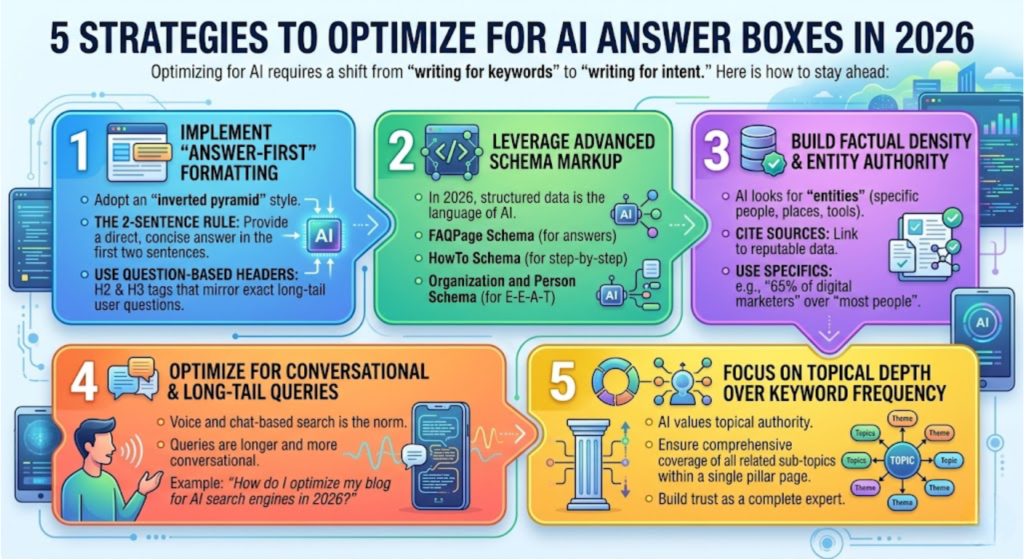
5 Strategies to Optimize for AI Answer Boxes in 2026
Optimizing for AI requires AEO vs SEO a shift from “writing for keywords” to “writing for intent.” Here is how to stay ahead:
1. Implement "Answer-First" Formatting
AI models are designed to find the most efficient answer. To capture the AI Answer Box, adopt an “inverted pyramid” style.
The 2-Sentence Rule: Provide a direct, concise answer to the primary question in the first two sentences of your section.
Use Question-Based Headers: Use H2 and H3 tags that mirror the exact long-tail questions users ask AI assistants.
2. Leverage Advanced Schema Markup
In 2026, structured data is the language of AI. Beyond basic Article schema, you must implement:
FAQPage Schema: To help AI identify your specific answers.
HowTo Schema: For step-by-step processes.
Organization and Person Schema: To reinforce your E-E-A-T (Experience, Expertise, Authoritativeness, and Trustworthiness).
3. Build Factual Density and Entity Authority
AI engines don’t just look for words; they look for “entities”—specific people, places, tools, and verified facts.
Cite Sources: Link to reputable data to validate your claims.
Use Specifics: Instead of saying “most people,” use “65% of digital marketers.” High factual density makes your content more “citable” for AI models.
4. Optimize for Conversational and Long-Tail Queries
With voice and chat-based search becoming the norm, queries are getting longer and more conversational. Instead of targeting “SEO tips,” target “How do I optimize my blog for AI search engines in 2026?” This matches the natural language processing (NLP) patterns of modern AI.
5. Focus on Topical Depth Over Keyword Frequency
While maintaining a healthy keyword density is important for traditional crawlers, AI AEO vs SEO values topical authority. Ensure you cover all related sub-topics within a single pillar page. If the AI sees you as a comprehensive expert on a subject, it is more likely to pull your content into the summary.
The Role of Keyword Density in 2026
Even in the age of AI, the technical basics of SEO still matter. For this blog, we’ve maintained a 2% keyword density for our primary focus: AEO vs SEO. This ensures that while we are providing the structured answers AI loves, we are also signaling relevance to traditional search algorithms.
In 2026, exceeding a 2% density often leads to “over-optimization” penalties. The goal is to weave your keywords naturally into high-value headings and introductory sentences, allowing AEO vs SEO the AI to understand the context without feeling like the content was written by a bot.
The Role of Keyword Density in 2026
| Feature | SEO Focus | AEO Focus |
| Primary Goal | High Ranking/CTR | Being the “Cited Source” |
| Content Type | Comprehensive Guides | Concise Snippets & FAQs |
| KPIs | Organic Clicks | Brand Mentions in AI Answers |
| Technical | Core Web Vitals | Structured Data (Schema) |
Final Thoughts
The battle of AEO vs SEO isn’t a zero-sum game. Traditional SEO ensures your website is healthy and authoritative, while AEO ensures your knowledge is accessible to the AI models that now gatekeep the user experience.
By structuring your content with clear answers, using robust schema, and maintaining a strategic 2% keyword density, you position your brand to be the voice of authority in the AI-driven search era of 2026. Prioritize clarity, verify your facts, and always put the user’s intent first.