
Generative Engine Optimization (GEO)
The digital marketing landscape is currently undergoing its most significant transformation since the invention of the search engine. We have officially moved beyond the era of the “10 blue links.” Today, users are increasingly turning to AI-powered platforms like ChatGPT, Perplexity, and Google AI Overviews to get direct, conversational answers.
For marketers, this shift introduces a new challenge: Generative Engine Optimization (GEO). Unlike traditional SEO, which focuses on ranking at the top of a page, GEO is about ensuring your content is the primary source that AI models cite when generating an answer. If you aren’t being cited, you effectively don’t exist in the AI-driven search journey.
To help you stay ahead, we have compiled the essential Generative Engine Optimization (GEO) tips to future-proof your digital strategy.
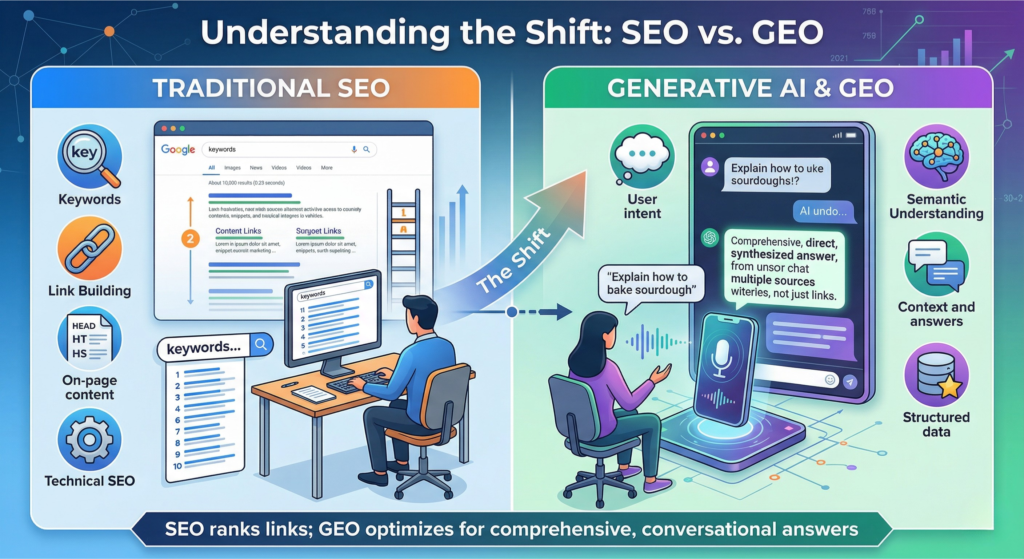
Understanding the Shift: SEO vs. GEO
In traditional SEO, we optimized for crawlers and keywords. In the world of Generative Engine Optimization (GEO) tips, we optimize for Large Language Models (LLMs) and “citatability.”
AI engines don’t just look for keywords; they look for entities, facts, and authority. They synthesize information from multiple sources to create a single, cohesive response. Your goal is to provide the most “digestible” and “authoritative” piece of that puzzle.
Top Generative Engine Optimization (GEO) Tips for 2026
1. Prioritize Fact-Density and Statistics
AI models are trained to prioritize accuracy and verifiable data. One of the most effective Generative Engine Optimization (GEO) tips is to move away from fluff and toward “hard” information.
Include original research and data points
Use specific dates, percentages, and names.
Structure your facts clearly so an AI can easily extract them as a citation.
2. Structure Content for Easy Extraction
AI engines prefer content that is semantically clear. To align with modern Generative Engine Optimization (GEO) tips, you must use a rigid content hierarchy.
Use H2 and H3 tags as questions that users actually ask.
Include “TL;DR” summaries at the top of long sections.
Utilize Bullet Points: AI models love lists because they are easy to parse and reformat into conversational answers
3. Implement Advanced Schema Markup
Technical SEO is still relevant, but in GEO, it’s about “contextual signaling.” By using Schema.org markup (specifically FAQ, Article, and Person schemas), you are essentially giving the AI a map of your content. This is a foundational element among Generative Engine Optimization (GEO) tips because it reduces the “hallucination” risk for the AI, making it more likely to trust and cite your site.
4. Close the "Citation Gap"
AI doesn’t just read your website; it looks at the “echo” of your brand across the web.
Reddit and Quora: Ensure your brand is being discussed in community forums, as AI models heavily weight user-generated perspectives.
Niche Authority: Getting mentioned on authoritative industry sites is more important than ever. The more “nodes” in the digital ecosystem that point to your expertise, the higher your GEO score.
5. Focus on Natural Language and Intent
Keywords are becoming secondary to “intent clusters.” When applying Generative Engine Optimization (GEO) tips, write as if you are answering a person, not a machine. Use a conversational tone that mirrors the prompts users type into AI interfaces. Instead of “best running shoes,” focus on “What are the best running shoes for a marathon runner with flat feet?
Measuring Success in the GEO Era
The metrics we once lived by—clicks and impressions—are changing. In the age of Generative Engine Optimization (GEO) tips, you should start tracking:
AI Share of Voice: How often is your brand mentioned in AI-generated responses for your target topics?
Citation Frequency: How many times do LLMs link back to your domain as a source?
Sentiment Analysis: Is the AI describing your brand as a leader or a budget option?
Conclusion
The transition to AI-driven search isn’t a threat; it’s an opportunity for those who adapt early. By implementing these Generative Engine Optimization (GEO) tips, you ensure that your brand isn’t just a link on a page, but a foundational part of the answers users receive.
Digital marketing in 2026 requires a blend of technical precision and human-centric authority. Start optimizing for the engines of tomorrow, today.