
AI Search Ranking in 2026: The Ultimate Guide to GEO and AI Overviews
The days of simply matching keywords to hit position #1 are officially over. In 2026, AI models don’t just index your content—they read it, synthesize it, and deliver the answers directly to the user.
If you have noticed a shift in your organic traffic recently, you are not alone. With the widespread adoption of Google’s AI Overviews, ChatGPT Search, Perplexity, and Gemini, users are increasingly getting their questions answered without ever needing to click on a website. Search has fundamentally changed from a “directory of links” to a conversational answer engine.
Welcome to the era of Generative Engine Optimization (GEO). If you want your website to survive and thrive, you need to become the source that AI trusts. Here is exactly how to rank in AI search results in 2026.
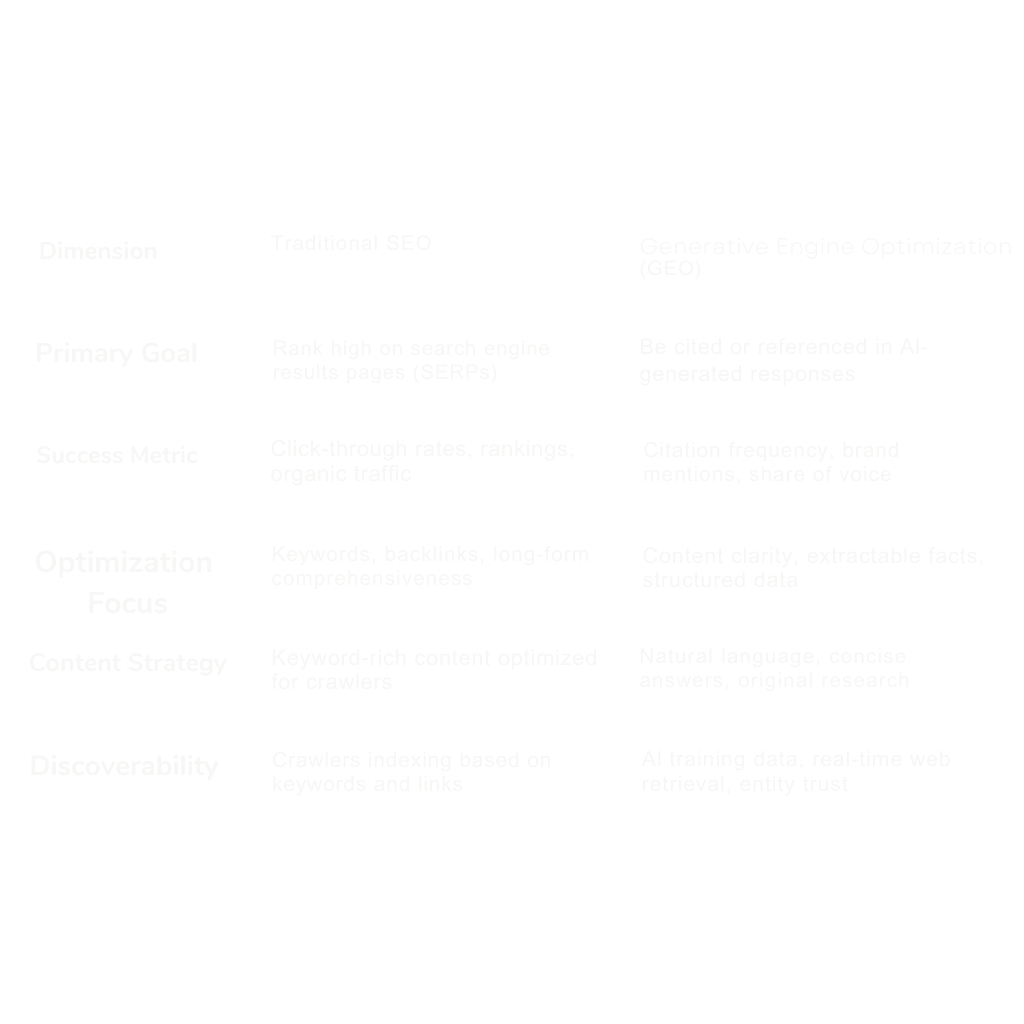
The Big Shift: Traditional SEO vs. GEO
Before diving into the tactics, you have to understand the fundamental difference between traditional Search Engine Optimization (SEO) and Generative Engine Optimization (GEO). AI systems don’t care about your keyword density; they care about context, facts, and structure.
The 5-Step Playbook to Rank in AI Chatbots and Overviews
To get models to cite your brand, you need to make your content impossible for them to ignore. Here is the framework working right now.
1. Prioritize "Information Gain" (Original Data)
Large Language Models (LLMs) synthesize existing information. If your blog post is just a rewrite of the top five articles on Google, AI has zero reason to cite you. You must provide Information Gain—something cannot find anywhere else.
Publish original research: Run surveys, analyze your internal customer data, and publish the raw numbers.
Share first-hand experience: Use case studies, personal anecdotes, and proprietary frameworks. If you own the only source of a specific fact or statistic, the AI must cite you to use it.
2. Structure for Machine Readability (The Extractable Answer)
AI models are smart, but they are lazy readers. They want clear, structured information that is easy to extract and summarize. If your answers are buried under a wall of text, you will lose the citation.
-
Use Question-Based Headings: Make your H2s and H3s match the exact conversational questions users ask (e.g., “How Does Search Optimization Work?”).
-
Front-Load the Answer: Immediately following the heading, provide a direct, concise answer in 40–60 words.
-
Embrace Formatting: Use bullet points, numbered lists, and simple comparison tables. Models heavily favor structured formats when building their summaries.
3. Build an Invincible "Entity Moat" (E-E-A-T)
Experience, Expertise, Authoritativeness, and Trustworthiness (E-E-A-T) are more critical than ever. Systems verify your credibility not just by what is on your website, but by how you are talked about across the internet.
Brand mentions matter: Unlinked brand mentions on highly trusted sites (like Reddit, industry forums, YouTube, and news outlets) act as trust signals.
Transparent authorship: Clearly show who wrote the content, link to their professional credentials, and explain why they are qualified to speak on the topic.
4. Optimize for Conversational Intent
People don’t search like robots anymore. Instead of typing “best running shoes 2026,” they ask their voice assistant, “What are the best running shoes for someone with flat feet training for a marathon?”
Target long-tail, hyper-specific queries.
Write in a natural, conversational tone. Avoid academic jargon unless you are writing for an academic audience.
Answer the unasked follow-up questions. Anticipate what the user will need to know next and include it in your content cluster.
5. Lock Down Your Technical SEO
Even the best content will fail if AI bots cannot access it. Technical SEO is the foundation that allows GEO to work.
Check your robots.txt: Ensure you aren’t accidentally blocking crawlers (like
ChatGPT-UserorGoogle-Extended).Implement Schema Markup: Use FAQ, Article, Organization, and How-To schema heavily. This translates your content into the exact language machines speak.
Avoid Client-Side Rendering for Core Text: If your most important answers load via JavaScript after the page renders, bots might miss them entirely. Hard-code your most valuable facts in the HTML.
The Future is Context, Not Keywords
The days of tricking algorithms are behind us. The websites that win in 2026 and beyond will be the ones that act like true authorities—publishing original insights, structuring data beautifully, and answering user questions with unparalleled clarity. Stop optimizing for the algorithm, and start optimizing for the answer.